
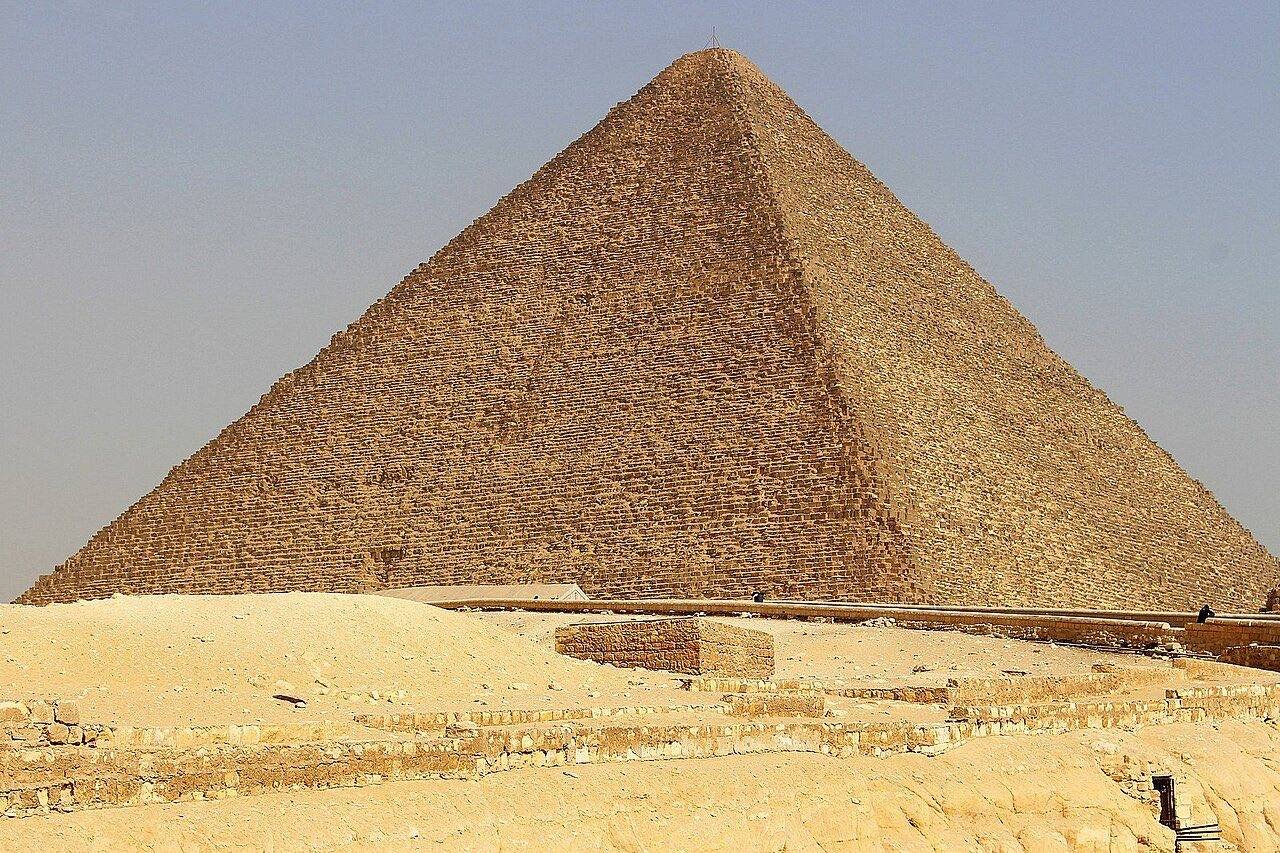
Subject ·
The Great Pyramid
One building, three layers, and a century and a half of people finding numbers in it.
The is the most measured building on Earth, and the one most often read as a message. This page keeps the two apart. The ground is ’s survey, the , and the . The teachings are ’s and ’s inherited craft. The readings run from to . Every honey word opens a note.
Linked terms open a short note. Who said what stays in the prose.
Log scale, older to the left. Ra’s date and Grant’s are both older than Khufu’s reign by thousands of years. Sitchin’s forgery claim is answered by a papyrus found thirty-three years after he made it.
Khufu, about 2560 BCE, with a logbook to prove it.
The Great Pyramid belongs to the reign of Khufu, fourth dynasty, about 2589 to 2566 BCE, as one step in a sequence that runs through Meidum and Dahshur. Three kinds of evidence fix it there. The south of the plateau, with its bakeries and galleries. The painted inside the sealed chambers above the King’s Chamber. And since 2013 the , a papyrus logbook in which a boat crew hauls casing stone from Tura to “the Horizon of Khufu” in the king’s own reign. , visiting two thousand years later, already names Cheops and calls it a tomb. Nothing found on the plateau is older than the dynasty.
A slope of 51.84°, and why that is also 7.2 squared.
measured the casing angle at about 51°52′ in 1881, and later work settles near 51°50′. In decimal degrees that is , and 7.2 × 7.2 = 51.84, the observation at the centre of Grant’s chapter on the number 72. The arithmetic holds. Egyptology reaches the same angle another way: the , the builders’ measure of slope, set at 5½ palms of run for each cubit of rise, gives arctan(7 ÷ 5.5) = 51.84°. The second pyramid shows the same rule at work. rises 4 for every 3 and its half-base, height, and face make the first Pythagorean triangle, from a seked of 5¼. The at Dahshur has two sekeds, 5 and 7½. Whole-number ratios on a measuring rod produce every constant later readers have found in these buildings. That does not prove the builders meant nothing more. It does mean the constants are not evidence that they did.
Raised by thought, about 6,000 years before the sessions, for initiation and healing.
In Sessions 3 and 23 of the Law of One, describes the Great Pyramid as built by : the energy of matter handled through consciousness, with local people taking part, as a tool for initiation and healing whose proportions intensified the work. A later priesthood closed what had been open. Ra’s date is about 6,000 years before 1981, which places the building some 1,400 years before Khufu. Sessions 58 and 59 add a geometry of frame pyramids and spiralling light and name a position inside the pattern that Ra calls the prana vacuum. The teaching is internally consistent and dated. It is kept here as a teaching.
Inherited knowledge, passed through mystery schools.
In the 2006 interview known through a third-party transcript, stresses mathematics, vibration, sound, and chemistry, handed down through mystery schools: a transmission of knowledge rather than a crew of visitors setting every stone. The catalogue session A Step Along the Way lists Giza beside Göbekli Tepe and the . The official recordings hold the detail; this site has only the summary. Bashar’s picture is compatible with Egyptian builders and does not require a different date. Ra’s is not, and does.
One chamber, two sets of marks, two kinds of claim.
The is a granite room of 20 by 10 cubits with a lidless too wide to have come through the passage. In 1837 Howard Vyse blasted into the relieving chambers above it and found red-ochre gang marks naming Khufu, the . In 2018 Robert Edward Grant photographed two debossed shapes on the rim of the coffer that he reads as Α and Ω, the . The first set is in the literature, positioned under blocks, and now backed by the . The second has no Egyptological assessment that this site could find. Both are claims about marks in the same room. One has been tested for 188 years, the other for eight.
Sitchin, 1980, and why a Red Sea harbour answers it.
Zecharia argued in The Stairway to Heaven that Vyse painted the Khufu marks himself to reward his backers. Grant repeats the suspicion, writing that the marks “are most probably forgeries made 150 years ago”. Egyptologists had already rejected it on the marks’ positions and grammar, but the decisive answer came from elsewhere. In 2013 Pierre Tallet’s team found the at Wadi al-Jarf, a logbook from Khufu’s reign that names his pyramid and the stone going to it, buried 150 kilometres from Giza and three decades after Sitchin wrote. A forger in 1837 could not have arranged that. The claim is kept here as the clearest case on the site of a reading overtaken by a find.
A number code, a near miss, and a Renaissance detour.
and Talal Ghannam’s (2021) treats the pyramid as a vault of constants. The tools are the , which sorts numbers by their remainder on division by 9, and the chain 7.2, 72, 720, 25,920, which ties the face angle to . Beside it sit and its square, 186,624, offered as the speed of light in miles per second; the measured value is 186,282, a . From his blog comes the match between the pyramid’s latitude and the digits of c, the . The book’s fifth part lays a pyramid section over Leonardo’s Vitruvian Man, the , and argues from the Codex Atlanticus that saw the chambers himself. Each step is an alignment. None is a measurement that could have come out otherwise. That is what makes them readings, and what makes them worth showing in full rather than waving away.
Piazzi Smyth and the pyramid inch, 1864.
Grant is not the first. Charles Piazzi Smyth, Astronomer Royal for Scotland, published Our Inheritance in the Great Pyramid in 1864 and found in its dimensions a sacred inch, the Earth’s radius, and a prophetic calendar. went to Giza partly to test him and came back with a base length that did not fit. Petrie’s own later remark was that he had seen a theory die at the hands of a tape measure. The pattern repeats: each generation’s constants are found, each is answered by a better survey or a new find, and the building stays where it was.
Other stones the same readers use.
The , the picture on this site’s Anunnaki pages, carries a golden-rectangle overlay in Philomath; Grant himself asks whether it was meant. The at Abydos, where the is painted on Seti I’s pillars, is given an age of 10,000 BCE in the book against a dated layer of the thirteenth century BCE. And ’s 432,000 years before the Flood, with every reign a multiple of 3,600, is read by Grant as digital roots, by Sitchin as planetary orbits, and by Assyriologists as base-60 bookkeeping, a reading the older complicates by giving a different total. The same three layers, each time.
Still open
- Whether the Α and Ω shapes on the coffer rim are tool marks, later graffiti, or something else, and whether any Egyptologist has examined them. A dated assessment either way would close the item.
- How the heaviest granite beams were lifted to the King’s Chamber. Ramp theories differ among Egyptologists; the question is engineering, inside the Old Kingdom.
- Which of the two teachings a listener finds more coherent is for the recordings. On this page the open questions are about stone and paper.
Sources
- Ra. The Law of One, Session 3. L/L Research, 28 January 1981. llresearch.org.
- Ra. The Law of One, Session 23. L/L Research, 11 February 1981. llresearch.org.
- Ra. The Law of One, Session 58. L/L Research, 16 June 1981. llresearch.org.
- Ra. The Law of One, Session 59, 59.6–59.21. L/L Research, 25 June 1981. llresearch.org.
- Bashar, channeled by Darryl Anka. “An Interview with Bashar.” Bashar Communications, 15 May 2006. tv.bashar.org. Discussed via a third-party transcript (www.superphysics.org).
- Bashar, channeled by Darryl Anka. “A Step Along the Way.” Bashar Communications, 2021. tv.bashar.org.
- UNESCO World Heritage Centre. “Memphis and its Necropolis, the Pyramid Fields from Giza to Dahshur.” whc.unesco.org. Accessed 28 October 2026.
- Ancient Egypt Research Associates. “The Lost City of the Pyramids, the workers’ town at Giza.” aeraweb.org. Accessed 28 October 2026.
- W. M. Flinders Petrie (1883). The Pyramids and Temples of Gizeh. Field & Tuer, London (scan at the Internet Archive). archive.org.
- Pierre Tallet and Mark Lehner (2021). The Red Sea Scrolls: How Ancient Papyri Reveal the Secrets of the Pyramids. Thames & Hudson. www.thamesandhudson.com.
- Pierre Tallet (2017). Les papyrus de la mer Rouge I. Le « journal de Merer » (Papyrus Jarf A et B). Institut français d’archéologie orientale, MIFAO 136. www.ifao.egnet.net.
- Zecharia Sitchin (1980). The Stairway to Heaven. St. Martin’s Press. www.sitchin.com.
- Robert Edward Grant and Talal Ghannam (2021). Philomath: The Geometric Unification of Science & Art through Number. Self-published (KDP), first edition April 2021. robertedwardgrant.com.
- Robert Edward Grant. “Great Pyramid Discovery?, blog post on the Alpha-Omega marks.” robertedwardgrant.com. Accessed 28 October 2026.
- Sean Gallagher, Ars Technica. “Snake oil or genius? Crown Sterling tells its side of Black Hat controversy.” arstechnica.com. Accessed 28 October 2026.
- Henri Frankfort, with A. de Buck and B. Gunn (1933). The Cenotaph of Seti I at Abydos. Egypt Exploration Society, Memoir 39. www.ees.ac.uk.
- Gerald P. Verbrugghe and John M. Wickersham (translators) (1996). Berossos and Manetho, Introduced and Translated: Native Traditions in Ancient Mesopotamia and Egypt. University of Michigan Press. press.umich.edu.
- ETCSL, University of Oxford. “The Sumerian king list, Electronic Text Corpus of Sumerian Literature.” etcsl.orinst.ox.ac.uk. Accessed 28 October 2026.
- Capitaine, N., Wallace, P. T., and Chapront, J. (2003). Expressions for IAU 2000 precession quantities. Astronomy & Astrophysics. doi:10.1051/0004-6361:20031539
Dig further
- Thought-form, inherited craft, or Old Kingdom labourThe short article this page grew from.
- A pyramid in the yardJim McCarty’s frame and Sessions 58 and 59.
- Zero point and the prana vacuumTwo uses of one phrase.
- Anunnaki: gods, donors, or minersWhere Berossus and the Tablet of Shamash live.
- The sites, Old WorldThe Osireion beside Malta and Derinkuyu.
- How to read three layersThe method this page uses.