

Inventor · 1856–1943
Nikola Tesla
Nikola Tesla helped establish the electrical systems that made large-scale modern industry possible. His work on rotating magnetic fields, polyphase alternating current, and induction motors connected an elegant physical principle with machinery that could perform useful work. He also investigated high-frequency electricity, wireless transmission, remote control, lighting, and turbines. Some projects became durable technologies; others remained experiments or ambitious proposals. His reputation now encompasses both that substantial engineering record and a much larger mythology about suppressed discoveries and unlimited energy.
Tesla’s life illuminates how invention becomes part of society. An idea needs equipment, manufacturing, finance, and people prepared to use it. He sometimes brought these elements together. At other times, the scale of his vision outran the evidence and resources available. Understanding his legacy means following those differences without losing sight of the imagination that made the achievements possible.
A European childhood and an American career
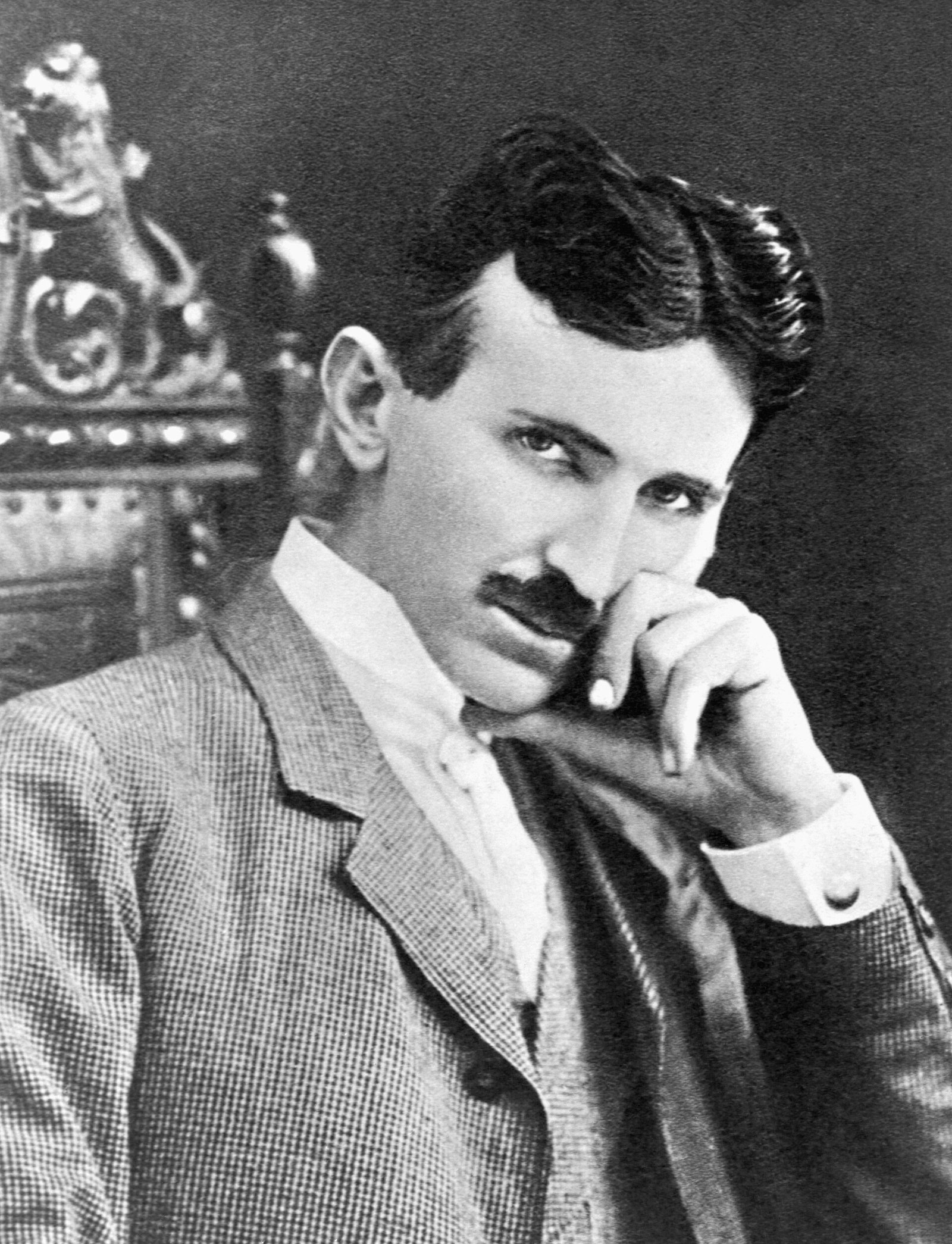
Tesla was born on 10 July 1856 in Smiljan, then in the Austrian Empire and now in Croatia, into a Serbian family. His father was an Orthodox priest. His mother’s skill in making household devices impressed him deeply, and he later credited her inventive intelligence. He studied engineering in Graz but did not graduate. Employment in Budapest and with the Continental Edison organisation in Paris brought him into the developing worlds of telephony and electrical machinery.[1][2][3]
His autobiography, My Inventions, describes unusually vivid mental imagery. He claimed that he could visualise a machine, alter its design, and imagine its operation before building it. These recollections reveal how he understood his creative process. They are personal testimony, written decades after the experiences, rather than independently measured accounts of exceptional mental powers.[2]
In 1884 he moved to the United States and briefly worked for Edison. He subsequently pursued his own ventures, including arc lighting, before securing support for his motor research. This was an uncertain beginning, not a direct passage from insight to wealth. The later celebrity emerged from a period when finding backers and establishing ownership of inventions were immediate practical concerns.[1][4]
The rotating magnetic field
Tesla’s central motor insight concerned a magnetic field that rotates although the coils producing it remain stationary. Alternating currents passing through differently positioned windings at different phases create a magnetic pattern moving around the motor. That changing field can induce currents in a rotor and produce torque.[5][6]
The importance becomes clearer beside a familiar mechanical problem. Direct-current motors commonly used brushes and commutators to manage electrical connections as parts rotated. These components introduced wear, sparking, and maintenance. An induction motor could develop useful rotation without making those particular electrical contacts to its rotor. The Smithsonian’s surviving Westinghouse motor makes this achievement tangible: it is an actual manufactured machine, not simply a retrospectively celebrated diagram.[6]
Tesla’s patents also show that he considered arrangements of generators, circuits, and motors together. His work translated electromagnetic behaviour into a practical system of controlled movement. The principle helped electricity become a source of mechanical labour as well as illumination.[5]
He was not alone in investigating rotating fields. Galileo Ferraris independently developed the principle and experimental motors in Italy. Recognising that parallel work strengthens the history: several investigators were confronting related problems, while Tesla developed a particularly consequential group of designs and commercial relationships.[7]
Turning an invention into an electrical system
George Westinghouse licensed Tesla’s important AC patents in 1888. Westinghouse’s engineers developed and manufactured equipment from the ideas, connecting invention with industrial production. The Henry Ford’s preserved motors explicitly document this relationship between Tesla’s patents and the company’s engineering work.[8]
Alternating current offered a major advantage in transmission because transformers could change its voltage efficiently. Raising voltage reduced the current needed to deliver a given power, limiting resistive losses along transmission lines. Voltage could then be lowered for local use. Tesla’s motors helped complete the practical argument by making AC useful for driving machinery.[9]
The resulting network was a collective accomplishment. Generators, transformers, insulation, switching, distribution, and reliable manufacturing all mattered. Tesla’s contribution was exceptional without requiring him to have invented every component of electrification. His achievement becomes more impressive when understood as a solution that other engineers could develop and deploy.
The “War of Currents” therefore involved more than a contest between Tesla and Edison. Competing firms, investment, safety arguments, and alternative infrastructures shaped the outcome. AC became dominant for much power distribution, while modern electronics and high-voltage transmission also make extensive use of DC. The technical history never resolved into one current being universally superior.[9]
Its importance appears in ordinary uses of electricity. Motors let electrical energy perform mechanical tasks in industry and domestic appliances, including washing and drying clothes. Generating power at one location and converting it into motion elsewhere changed what a distribution network could accomplish. Later engineers improved materials, controls, and manufacturing, so the machines in service today are not simply unchanged nineteenth-century designs. The enduring inheritance is a way of organising currents and magnetic effects that subsequent designers could adapt. This is the practical foundation beneath the more theatrical public image of Tesla’s work.[10]
Chicago and Niagara
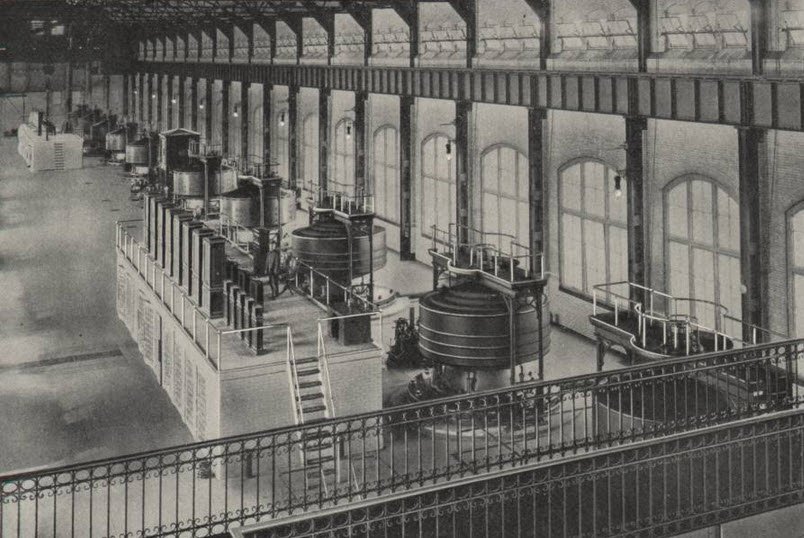
The 1893 World’s Columbian Exposition in Chicago gave Westinghouse’s AC system an enormous public stage. Lighting and demonstrations made the new electrical possibilities visible to visitors. Tesla’s own exhibits included motors and devices showing what rotating magnetic fields could accomplish.[9][11]
Niagara Falls gave the approach an even more substantial test. The generating station began producing power in 1895, and transmission to Buffalo followed in 1896. Smithsonian records identify the first generator’s original characteristics: two-phase alternating current, 2,200 volts, and 5,000 horsepower. Such details show an engineered installation with measurable performance.[12]
Tesla’s ideas were central to the polyphase system, but the generators were designed and built by Westinghouse within a much larger undertaking. A contemporary report of Tesla’s 1896 visit lists company leaders, engineers, and the power project’s organisers alongside him. The scene captures technological success as cooperation among people with different responsibilities.[13]
Niagara also changed the geographical imagination of electricity. Power could be generated where a natural resource existed and delivered elsewhere for work. Tesla had helped connect a waterfall with factories and cities. This accomplishment needs no secret mechanism to explain its scale or lasting importance.
High frequency electricity and the Tesla coil
During the 1890s Tesla explored electrical oscillations at frequencies and voltages far above those used in ordinary power distribution. The apparatus associated with the Tesla coil uses coupled circuits and oscillatory behaviour to produce high voltages. His 1891 lighting patent documents this experimental programme.[14]
The coil became an enabling research instrument. It supplied conditions for studying discharges, lamps, insulation, and electrical effects that were difficult to produce with conventional machinery. Its dramatic sparks also gave the public an unforgettable image of electricity apparently escaping familiar boundaries.
Tesla’s lectures described light produced in evacuated tubes and arrangements that reduced or altered ordinary connecting wires. The experiments belonged to a broad contemporary investigation of electrical illumination. They contributed important techniques without making every later fluorescent lamp or wireless device a direct copy of his apparatus.[11][14]
Thomas Commerford Martin’s 1894 compilation preserves lectures, patents, and contemporary descriptions. Its contents show the range of questions Tesla was pursuing, from motors to high-potential lighting. Its enthusiastic preface also establishes that his importance was recognised during his productive years. Public admiration did not begin only after his death.[11]
Demonstration and experimental risk
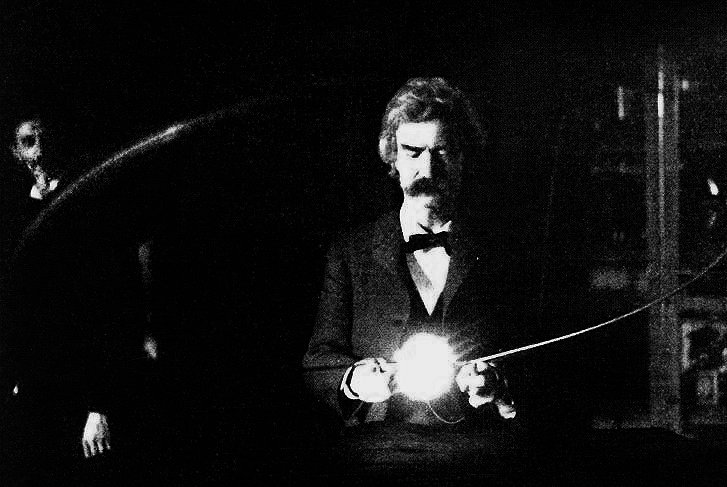
Tesla made laboratory work into an encounter. Mark Twain visited, and photographs show him participating in electrical demonstrations. The writer’s presence connects Tesla with a wider culture of theatre, literature, and public fascination with scientific possibility. These events attracted attention and potential support as well as communicating ideas.[15]
There were serious setbacks. A fire destroyed his New York laboratory in March 1895, including apparatus and experimental records. Contemporary reporting described the uninsured loss; another technical journal corrected exaggerated reports that he had suffered a mental collapse and noted his immediate return to work.[16][17]
Tesla also became an early investigator of X-rays following Röntgen’s discovery. His radiographs and published investigations are documented in the museum record and radiological scholarship. He examined damaging effects from experimental tubes as well as their imaging possibilities. His participation deserves recognition without transferring Röntgen’s discovery to him.[18][19]
Together these episodes reveal a working experimentalist. The famous photographs preserve striking moments, but the underlying career involved fragile equipment, rebuilding, uncertain interpretation, and effects whose consequences were still being learned.
Radio and the limits of a single inventor story
Tesla’s wireless patents describe tuned transmitting and receiving circuits. Resonance offered a way to make apparatus respond selectively to oscillations. His work belongs among the important contributions to radio’s development, alongside those of Hertz, Lodge, Marconi, Stone, and others.[20][21]
The 1943 United States Supreme Court decision in Marconi Wireless Telegraph Company v. United States is frequently simplified into a declaration that Tesla alone invented radio. The judgment did something more specific: it considered patent claims and prior art, including Tesla’s earlier disclosures, and invalidated claims involved in the litigation.[21]
The decision explicitly distinguished the patents before it from Marconi’s reputation for achieving successful radio transmission. It did not distribute sole authorship of an entire technological field. Recognising that scope protects Tesla’s genuine priority in particular arrangements while retaining the contributions of other inventors and developers.
Radio demonstrates why invention has several histories. A laboratory experiment, a patent, a practical communications service, and a profitable industry are different achievements. Tesla contributed crucial ideas and apparatus, while others established working services and pursued different technical approaches. Historical precision gives him a defensible place in that story without requiring every rival to disappear.
The remote controlled boat
In 1898 Tesla publicly demonstrated a boat controlled without a connecting wire and patented a method for controlling moving vessels or vehicles. The demonstration made a new relationship visible: instructions could cross space and cause a machine to act.[22]
This was more than a miniature nautical curiosity. It anticipated a general separation between operator and mechanism. Steering, switching, and movement could become responses to transmitted commands. Later remotely operated vehicles belong to a much larger technological history, but Tesla’s demonstration is an early, well-documented landmark within it.
He called this field telautomatics and imagined increasingly capable machines taking over human tasks. His discussions sometimes extended from remote control toward machines behaving as though they possessed intelligence. The demonstrated boat still depended on control from outside; it should not be retrospectively described as modern autonomous artificial intelligence.[2][22]
The distinction makes the achievement clearer. Tesla had shown a practical new form of command and response. His larger predictions asked how far that relationship might eventually be developed.
Colorado Springs and the planetary experiment
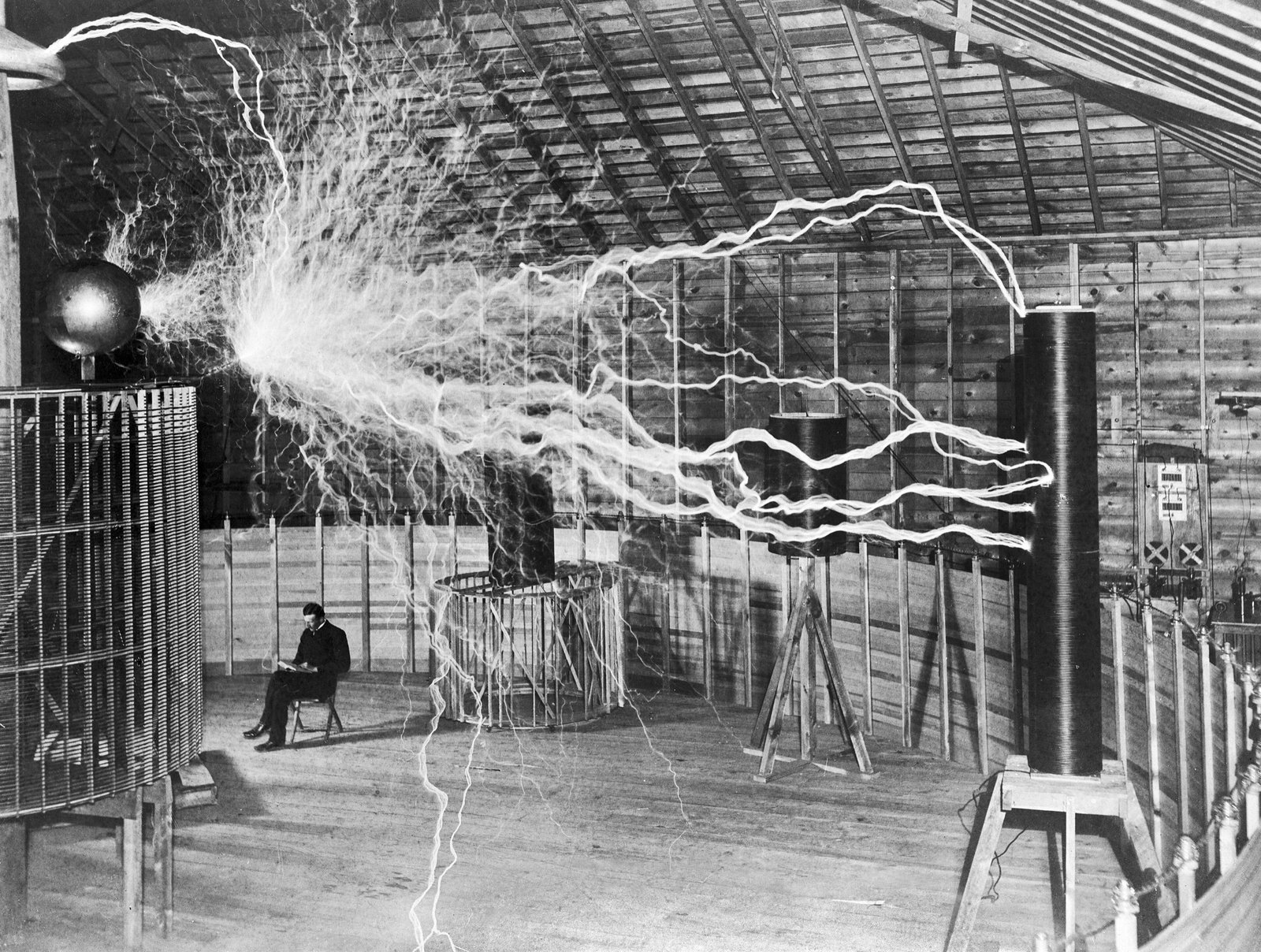
Tesla went to Colorado Springs in 1899 to pursue large-scale high-voltage experiments. He investigated powerful oscillations, electrical discharges, and what he believed could become a system for transmitting energy through the Earth and its surrounding environment.[23]
The work encouraged an extraordinary ambition: make the planet itself part of an electrical installation. Rather than construct a separate wire to every destination, he hoped appropriately tuned stations could exchange energy through natural media. His patents and published accounts record that intention.[20][23]
His confidence exceeded what had been established as a useful global system. Producing impressive discharges or detecting a distant disturbance does not determine how much usable energy reaches a load, how efficiently it arrives, or whether the system is economical. These are engineering questions that spectacular photographs cannot answer alone.
The experiments nevertheless enlarged his conception of communication. The same general project linked electrical energy, signals, geographical distance, and international cooperation. Colorado Springs supplied both real experimental work and the setting for conclusions whose full scale remained unproved.
Wardenclyffe and the unfinished world system
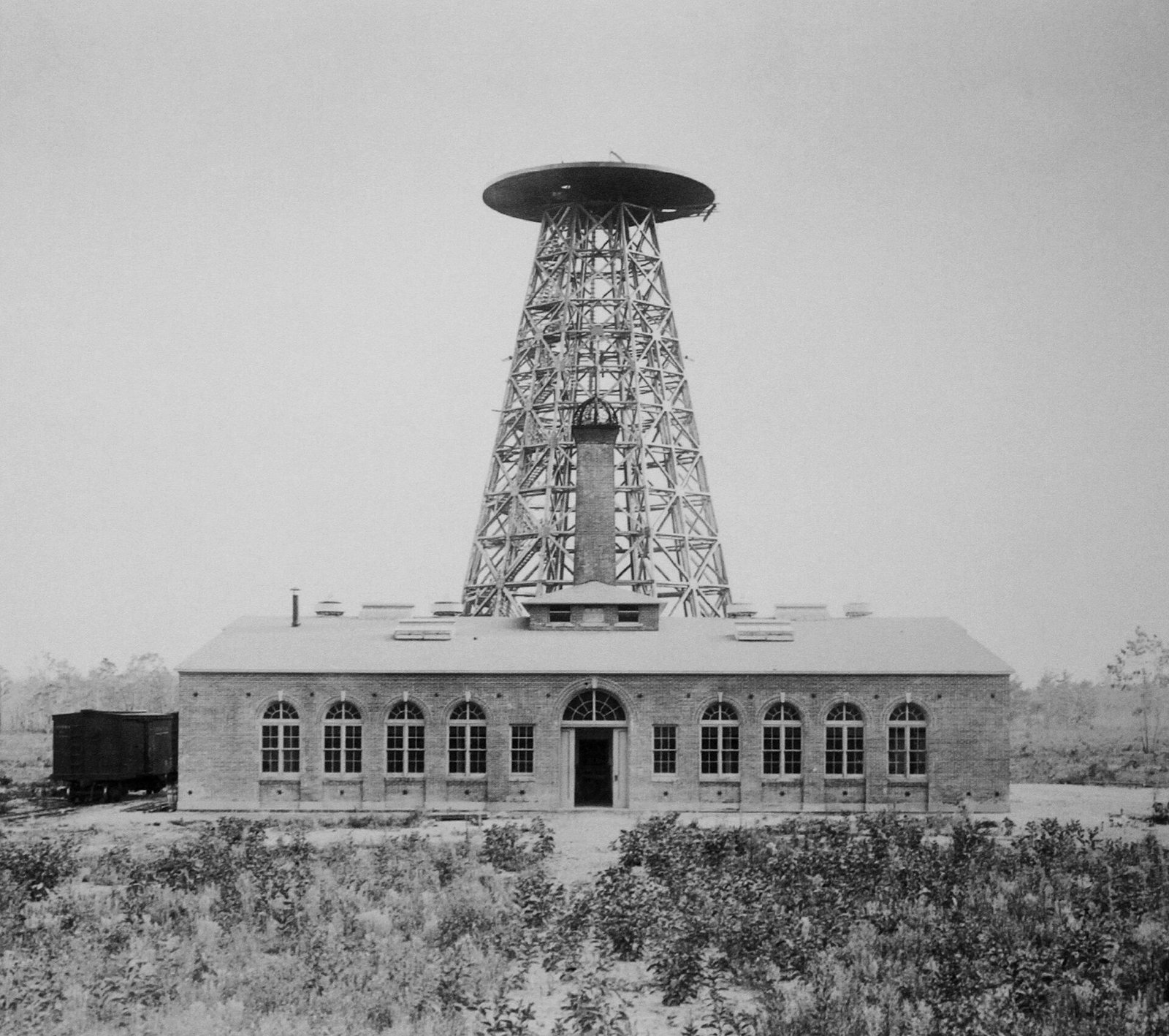
With initial support from J. P. Morgan, Tesla began developing Wardenclyffe on Long Island in 1901. Stanford White designed its laboratory building. The tower was intended as part of a worldwide wireless system, combining communications with Tesla’s larger ambition for power transmission.[24]
Messages, news, images, and other information could theoretically be distributed across great distances. The programme anticipated the social importance of global connectivity, although its proposed physical implementation differed from the systems that later succeeded. Anticipating a human need is not the same achievement as building the eventual technology that meets it.[25]
Costs, technical uncertainty, and inadequate further financing undermined the project. Wardenclyffe never became the working global installation Tesla envisioned. Its tower was dismantled in 1917. The surviving laboratory now carries the memory of a proposal whose influence greatly outlasted its construction programme.[24][25]
The project is often described as a suppressed source of free energy. Its transmission patents, however, explicitly include a source supplying electrical energy. Wireless delivery and energy generation are different functions. Avoiding a wire would not itself create power, remove conversion losses, or establish a working unlimited supply.[20]
Commercial interests certainly shaped the project’s opportunities. The surviving outcome does not establish the stronger story that a completed, practical global power technology was deliberately withheld. Wardenclyffe’s significance includes the distance between an ambitious design and a demonstrated service.
Radiant energy and environmental power
Tesla also investigated obtaining energy from the surrounding environment. His 1901 patent for an apparatus using radiant energy describes an insulated conductor, charge accumulation in a condenser, and a circuit that makes use of the accumulated charge. Its stated sources include sunlight and other radiation. This is a concrete historical disclosure and a different question from transporting electricity between stations.[26]
The interest behind it deserves to be taken seriously. Nature contains energy flows that machinery can capture, and Tesla wanted to expand the range of available sources. His thinking was broader than the electricity already supplied by familiar generators. The patent, however, does not document a machine producing unlimited power without an identifiable input. Energy collected from radiation remains energy arriving from somewhere.
Distinguishing these ideas makes room for investigation. A proposed collector can be studied through the radiation reaching it, the charge accumulated, and the useful output. Describing an environmental source as freely available says something about access and cost; it does not dispense with measuring the conversion process or demonstrate the performance of a complete generating system.
Turbines and other mechanical inventions
Tesla continued inventing beyond his best-known electrical period. His turbine patent, issued in 1913, describes fluid transferring energy to closely spaced smooth discs through adhesion and viscosity. This differs from directing flow against conventional blades.[27]
The idea remains interesting because it approaches energy transfer through another physical interaction. It does not establish that every proposed version outperforms conventional turbines. Useful comparison requires operating conditions, measured output, efficiency, durability, and an appropriate application.
His patent record also includes pumps, meters, regulators, lighting equipment, and an aircraft proposal. The Nikola Tesla Museum identifies 112 registered United States patents and many foreign equivalents. Counting patents requires care because the same invention could be protected in several countries.[4]
The range demonstrates sustained inventive activity. It also cautions against treating every patented device as an equally successful contribution. A patent identifies a protected disclosure; adoption and practical performance have their own histories.
His 1928 aerial-transportation patent proposed a machine combining vertical ascent with forward flight. He was still seeking ways to reorganise familiar physical forces into a different system of movement. The document establishes an aviation proposal, not a successfully flown aircraft or priority over every later vertical-takeoff design. Read beside his turbine and motor patents, it shows continuity in his interests: how to produce motion, control it, and make it serve a useful purpose.[28]
Energy and human progress
Tesla’s 1900 essay, “The Problem of Increasing Human Energy,” placed invention within a broad programme of human improvement. Food production, reducing destructive conflict, and obtaining more useful power became parts of one project. He considered solar energy, water power, and ways machinery could reduce exhausting labour.[29]
His mechanical analogy for humanity was expansive and sometimes strained. It nevertheless reveals a serious question behind the apparatus: what should increased power make possible? Electricity mattered because it could change the conditions of ordinary life, not simply because it produced dramatic effects.
A 1926 interview offered a particularly memorable forecast of portable wireless devices through which people could hear and see one another across the world. The resemblance to later mobile communication is striking. It is evidence of perceptive anticipation, not proof that Tesla had designed the semiconductor electronics, networks, and software of contemporary phones.[30]
His future included social transformation through machines. Predictions varied in accuracy, but he repeatedly understood technology as something that could reorganise relationships and everyday possibilities. That breadth helps explain why his reputation extends beyond specialists in electrical engineering.
Signals and the possibility of other worlds
Tesla’s curiosity also reached beyond Earth. In “Talking with the Planets,” published in 1901, he discussed disturbances detected during his western experiments and the possibility that they represented purposeful signals. He imagined establishing communication through elementary numerical patterns, allowing two parties first to recognise intelligence and then develop a more elaborate exchange.[31]
This is an authentic source for his interest in extraterrestrial communication. It is not evidence that he contacted another civilisation or received his inventions from one. His interpretation required discrimination between an intelligent source, terrestrial transmissions, natural electrical activity, and instrumental effects. The published account did not establish that chain of identification.
The episode helps explain why later writers recruit him into very different cosmologies. He genuinely entertained large possibilities. The historical task is to preserve what he proposed, what he observed, and what he inferred as distinguishable parts of the same inquiry.
Religion philosophy and spiritual interpretations
Tesla grew up with Orthodox Christianity and later engaged with ideas beyond it. A February 1896 letter by Swami Vivekananda records their meeting and Tesla’s interest in Vedantic concepts including prana, akasha, and cosmic cycles. Vivekananda hoped Tesla might supply a mathematical connection between matter, force, and potential energy.[32]
The letter documents a significant exchange and an anticipated investigation. It does not establish that the proposed demonstration was completed, or that Tesla experimentally proved Vedanta. Its value is historical: a leading religious thinker and an electrical inventor were exploring whether their conceptual languages could meet.
Later spiritual interpretations also attach Tesla to Walter Russell’s cosmology. The University of Science and Philosophy repeats an account that he advised Russell to conceal his science for a thousand years. This is a claim preserved by Russell’s institution; it should not carry the weight of an independently authenticated scientific endorsement.[33]
Tesla’s own philosophical statements also resist a simple mystical portrait. In his 1935 interview he described a mechanistic universe and associated mental life with bodily functioning. Interest in religious ideals, unusual imagination, and physical speculation did not amount to one consistent doctrine of spiritual consciousness.[34]
The difficult later years
Tesla’s later career brought financial constraints and increasingly ambitious public announcements. His proposed defensive particle-beam system, often called a death ray, exemplifies the difference between a declared capability and an established working installation. He hoped a sufficiently powerful defence could make attack futile and prevent war.[34]
His social vision also contained troubling commitments. The same 1935 interview endorsed eugenics and preventing people deemed unfit from reproducing. These views cannot be reconciled with an uncomplicated portrait of universal humanitarianism. Technical brilliance did not make all his moral judgments admirable or all his predictions sound.[34]
He never married or had children, and accounts of his later life describe growing solitude and his affection for pigeons. These details have become central to the popular image of the eccentric genius. They should leave room for the earlier sociable inventor who enjoyed cultural life and attracted prominent visitors. A life extending across several decades cannot be adequately represented by its final hotel room.[35]
He died in New York on 7 January 1943. His papers attracted government attention during wartime. The FBI’s official account distinguishes its own files from the actions of the Alien Property Custodian, which temporarily took possession of his effects despite his American citizenship.[36]
The subsequent transfer of his belongings to Yugoslavia helped establish the Nikola Tesla Museum in Belgrade. Its collections preserve documents, photographs, instruments, and drawings that allow research to proceed beyond anecdote. The archive’s existence matters more to historical understanding than rumours that all decisive evidence vanished.[37]
The archive preserves the difference between surviving evidence and retrospective reconstruction. The Belgrade museum reports more than 160,000 original documents, alongside technical objects, books, photographs, plans, and drawings. These holdings make it possible to investigate the development of an idea rather than relying only on its most famous description. Letters may reveal what an investor understood; successive drawings may show revision; a patent can be compared with a later claim. No single document answers every question, but an accessible body of records lets interpretations remain open to correction instead of depending on loyalty to a heroic image.[37]
Recognition during his lifetime
Tesla’s professional recognition included the Edison Medal, presented by the American Institute of Electrical Engineers in May 1917. The surviving meeting record contains tributes and his acceptance speech. Receiving an award bearing Edison’s name is a useful reminder that the profession’s relationships were more complicated than the later picture of permanent opposing camps.[38]
He did not receive a Nobel Prize. The Nobel archive records a nomination in 1937. The 1915 physics award, around which stories of a proposed Tesla–Edison prize developed, went to William Henry and Lawrence Bragg. A nomination, a newspaper rumour, and an awarded prize are different historical events; they should not become a story of Tesla refusing an honour that the official award record does not give him.[39][40]
What contemporaries said
Tesla received strong admiration from engineers who understood the consequences of his work. In a 1931 birthday letter, B. A. Behrend referred to the enormous quantity of machinery designed using Tesla’s system and placed his contribution alongside Faraday’s foundational discoveries. This praise concerned industrial achievement already realised.[41]
Albert Einstein’s birthday message in the same year congratulated Tesla as a successful pioneer in high-frequency energy. It is a documented expression of respect. It does not authenticate the often-repeated story that Einstein declared Tesla the world’s smartest man, nor does professional admiration imply agreement with every theory.[42]
Praise was accompanied by criticism. In 1900 T. H. Muras challenged the broad conclusions and lack of precise experimental reporting in Tesla’s Century essay. A separate review in Science distinguished his electrical accomplishments from his forecasts and philosophical claims, attacking the latter forcefully.[43][44]
These responses show that contemporaries could admire particular achievements while disputing the wider interpretation. Tesla was neither universally ignored nor uniformly accepted. His fame created an audience, and that audience included readers prepared to ask whether the demonstration supported the announcement.
Historians institutions and the modern legacy
Historian W. Bernard Carlson describes Tesla as an “idealist” inventor seeking a compelling physical realisation of a broad principle. Carlson also emphasises his cultivated celebrity and persuasive demonstrations. This interpretation restores agency to Tesla: he actively created his public identity as well as suffering financial disappointments.[45]
Branimir Jovanović, interviewed while directing the Belgrade museum, stressed a different aspect: the inventor’s extraordinary imagination and difficulty negotiating commercial life. The two interpretations need not exclude one another. A persuasive public performer can still struggle to finance a complicated project and convert attention into lasting income.[35]
Carlson’s lectures note Tesla’s renewed visibility through the electric-car company bearing his name and comics, games, and science fiction. These forms often favour the solitary visionary confronting incomprehension. The image has emotional force because invention can involve precisely that experience. It becomes less useful when it removes the partners, workshop labour, commercial decisions, and earlier discoveries that made an achievement possible. A cultural symbol can encourage people to study engineering, while the historical person offers a more demanding account of what creative work entails.[46]
Scientific institutions preserve a more specific legacy. The tesla is the SI unit of magnetic flux density. The American Physical Society’s Wardenclyffe recognition honours his contributions to AC machinery and wireless communication while distinguishing them from the unfulfilled global power project.[47][25]
The unit connects his name to everyday scientific practice. Magnetic flux density is expressed in teslas, including the fields used in magnetic resonance imaging. This commemoration recognises an electrical pioneer through a defined physical quantity. It supplies a durable remembrance because the name participates in measurement rather than depending on continued agreement about his personality or unfinished projects.[47][48]
His name also circulates through commercial branding and popular culture. That visibility helps renew interest but can detach the symbol from the engineer. The lasting opportunity is to let admiration lead back to machines, patents, correspondence, and measured results. Tesla changed the possibilities of electrical civilisation. His unfinished ambitions remain compelling precisely when their status is stated as carefully as his successes.
Sources
[1] MIT Lemelson Program, “Nikola Tesla.” Biography and early motor work. lemelson.mit.edu.
[2] Nikola Tesla, My Inventions, 1919. Autobiographical testimony, including mental imagery and telautomatics. en.wikisource.org.
[3] Tesla Science Center, “About Nikola Tesla.” Education and early biography. teslasciencecenter.org.
[4] Nikola Tesla Museum, “Patents.” Early ventures and the distinction between inventions and equivalent patents. tesla-museum.org.
[5] Nikola Tesla, US Patent 381,968, “Electro-Magnetic Motor,” 1888. patents.google.com.
[6] Smithsonian National Museum of American History, “Westinghouse AC induction motor.” americanhistory.si.edu.
[7] IEEE Milestones, “Rotating Fields and Early Induction Motors, 1885–1888.” Ferraris milestone proposal and documentation. ieeemilestones.ethw.org.
[8] The Henry Ford, “Experimental Westinghouse Induction Motor, Exhibited at the World’s Columbian Exhibition, 1889–1893.” thehenryford.org.
[9] US Department of Energy, “The War of the Currents: AC vs. DC Power.” energy.gov.
[10] US Energy Information Administration, “Tesla.” Applications of motors and the power system. eia.gov.
[11] Thomas Commerford Martin, The Inventions, Researches and Writings of Nikola Tesla, 1894. Contemporary preface, lectures, and apparatus descriptions. gutenberg.org.
[12] Smithsonian, “Westinghouse Niagara Falls generator, 1895.” si.edu.
[13] “Nikola Tesla at Niagara Falls,” Electrical Review, 21 August 1896. Contemporary report reproduced by the Tesla Science Center. teslasciencecenter.org.
[14] Nikola Tesla, US Patent 454,622, “System of Electric Lighting,” 1891. patents.google.com.
[15] IEEE REACH, “Mark Twain in Nikola Tesla’s Lab.” Historical photograph and publication context. reach.ieee.org.
[16] “Destruction of the Tesla Laboratory by Fire,” Electrical Engineer, 20 March 1895. teslauniverse.com.
[17] “Tesla’s Lab Burning and Mental Collapse,” Electrician, 22 March 1895. Contemporary correction of sensational reporting. teslauniverse.com.
[18] Nikola Tesla Museum, “Writings.” Catalogue of his 1896–1897 X-ray investigations. tesla-museum.org.
[19] “Nikola Tesla and the Discovery of X-rays,” RadioGraphics, 2008. Analysis reproducing museum radiographs and correspondence. pubs.rsna.org.
[20] Nikola Tesla, US Patent 645,576, “System of Transmission of Electrical Energy,” 1900. patents.google.com.
[21] Marconi Wireless Telegraph Co. v. United States, 320 U.S. 1, 1943. Supreme Court judgment. supreme.justia.com.
[22] Nikola Tesla, US Patent 613,809, “Method of and Apparatus for Controlling Mechanism of Moving Vessels or Vehicles,” 1898. patents.google.com.
[23] Tesla Science Center, “Tesla’s Wireless Power.” teslasciencecenter.org.
[24] Tesla Science Center, “The Tower.” teslasciencecenter.org.
[25] American Physical Society, “Wardenclyffe.” aps.org.
[26] Nikola Tesla, US Patent 685,957, “Apparatus for the Utilization of Radiant Energy,” 1901. patents.google.com.
[27] Nikola Tesla, US Patent 1,061,206, “Turbine,” 1913. patents.google.com.
[28] Nikola Tesla, US Patent 1,655,114, “Apparatus for Aerial Transportation,” 1928. patents.google.com.
[29] Nikola Tesla, “The Problem of Increasing Human Energy,” Century Magazine, June 1900. teslauniverse.com.
[30] John B. Kennedy, interview with Tesla, “When Woman Is Boss,” Collier’s Weekly, 30 January 1926. teslauniverse.com.
[31] Nikola Tesla, “Talking with the Planets,” Collier’s Weekly, 9 February 1901. teslauniverse.com.
[32] Swami Vivekananda, letter of 13 February 1896, Complete Works, volume 5, epistle LVII. en.wikisource.org.
[33] University of Science and Philosophy, “About Us.” Institutional account of the Russell and Tesla anecdote. philosophy.org.
[34] Nikola Tesla as told to George Sylvester Viereck, “A Machine to End War,” Liberty, 9 February 1935. teslauniverse.com.
[35] Smithsonian Magazine, “Nikola Tesla’s Struggle to Remain Relevant,” 2016. Direct interview with then museum director Branimir Jovanović. smithsonianmag.com.
[36] FBI, “The Top Ten Myths in FBI History,” 24 July 2008, item 10. Official account of the posthumous custody of Tesla’s papers. archives.fbi.gov.
[37] Nikola Tesla Museum, “History.” tesla-museum.org.
[38] American Institute of Electrical Engineers, minutes of the Edison Medal presentation, 18 May 1917. rastko.rs.
[39] Nobel Foundation, Tesla’s 1937 nomination record. nobelprize.org.
[40] Nobel Foundation, “The Nobel Prize in Physics 1915.” nobelprize.org.
[41] B. A. Behrend, letter to Tesla, 3 June 1931. teslauniverse.com.
[42] Albert Einstein, letter to Tesla, June 1931. teslauniverse.com.
[43] T. H. Muras, “Tesla on Energy,” Electrical Review, 22 June 1900. teslauniverse.com.
[44] “Mr. Tesla and the Universe,” Science, 21 September 1900. teslauniverse.com.
[45] W. Bernard Carlson, Tesla: Inventor of the Electrical Age, lecture and description, Microsoft Research, 20 September 2013. The interpretation cited is from the published lecture description. microsoft.com.
[46] University of Mary Washington, W. Bernard Carlson, “Nikola Tesla,” Great Lives lecture description. umw.edu.
[47] NIST, Guide to the SI, chapter 4, table 3. nist.gov.
[48] NIST, Sandy Ressler, “What’s in a Name? The Tesla,” 2023. Magnetic flux density and MRI. nist.gov.
Biography: Nikola Tesla · tesla-museum.org
Nikola Tesla helped make electricity a practical foundation of modern life. His rotating magnetic fields, polyphase alternating-current systems, and induction motors contributed to power networks capable of driving industry. He also investigated high-frequency electricity, wireless transmission, remote control, lighting, and turbines. His legacy combines working inventions with ambitious projects that remained unfinished, and a public image continually enlarged by later admirers.
Life and the making of an inventor
Born on 10 July 1856 in Smiljan, then in the Austrian Empire and now Croatia, Tesla came from a Serbian family. His father was an Orthodox priest; his mother’s ingenuity influenced him strongly. He studied in Graz without graduating and worked in Budapest and Paris before moving to the United States in 1884.[1][2][3]
After briefly working for Edison, he pursued independent ventures and secured support for his motors. His autobiography describes intensely vivid mental imagery and constructing machines in imagination before testing them physically. These are his recollections of creativity, not independently measured demonstrations of extraordinary powers.[2]
Tesla became a celebrated lecturer and experimentalist. Mark Twain visited his laboratory. A devastating fire in 1895 destroyed equipment and records, but contemporary reporting describes his immediate return to work.[4][5]
Inventions that changed electrical engineering
Tesla’s motor uses alternating currents in different phases to produce a rotating magnetic field. This induces currents and movement in a rotor without the brushes and commutator required by many earlier motors. Galileo Ferraris independently investigated rotating fields; Tesla developed particularly influential designs and commercial connections.[6][7][8]
Westinghouse licensed his AC patents in 1888 and developed equipment using them. Transformers made AC valuable for changing voltage and transmitting power efficiently; Tesla’s motors helped make it useful for mechanical work. Westinghouse’s Chicago exposition success in 1893 and Niagara’s generating station demonstrated the larger system. Niagara began operating in 1895; transmission to Buffalo followed in 1896.[9][10][11]
The Tesla coil emerged from his high-frequency research. Its high voltages supported investigations of discharges, lamps, and wireless effects. He also contributed early X-ray experiments after Röntgen’s discovery.[12][13]
His 1898 remote-controlled boat demonstrated commands transmitted without a connecting wire. It became an early landmark in remote operation, although it was not autonomous artificial intelligence. Wireless patents involving tuned circuits also contributed to radio. The 1943 Supreme Court decision recognised relevant prior art without declaring him radio’s sole inventor.[14][15]
His bladeless turbine transferred fluid energy through smooth discs. Other patents concerned pumps, regulators, and aerial transportation. Patenting an apparatus establishes a disclosure, not universal adoption or exceptional performance.[16][17][18]
Wireless ambitions and wider ideas
Colorado Springs experiments in 1899 encouraged Tesla’s vision of planetary wireless transmission. With initial backing from J. P. Morgan, he began Wardenclyffe in 1901. The project combined communication with a larger power-transmission ambition. Financial and technical difficulties prevented completion; the tower was dismantled in 1917.[19][20]
His transmission patents include an energy source. Delivering electricity without wires does not itself generate unlimited power. A separate radiant-energy patent explored collecting energy from environmental radiation, a proposal still requiring measurable input and output.[21][22]
Tesla anticipated portable wireless communication enabling people to hear and see one another across great distances. The resemblance to mobile phones shows perceptive foresight, not possession of modern electronics or networking technology.[23]
Vivekananda’s 1896 letter records Tesla’s interest in Vedantic ideas. It documents an exchange and hoped-for mathematical investigation, not proof that Tesla established spiritual doctrines experimentally. His reported interest in possible planetary signals likewise never established extraterrestrial contact.[24][25]
A complex legacy
Tesla sought inventions that could reduce labour and improve life, yet his social vision also included coercive eugenics. His proposed defensive particle-beam system remained distinct from a demonstrated weapon. Scientific brilliance did not guarantee sound predictions or admirable judgments.[26]
He died on 7 January 1943. Government examination of his effects later generated rumours; the FBI distinguishes its records from the Alien Property Custodian’s temporary possession. Much of his surviving archive reached the museum in Belgrade.[27][28]
Recognition of Tesla’s work did not wait entirely until after his death. The American Institute of Electrical Engineers presented him with the Edison Medal in 1917. The Nobel archive records a 1937 nomination, although he never received the prize. Such evidence complicates the familiar image of a completely forgotten inventor: financial hardship and unfinished projects coexisted with professional respect for achievements already incorporated into industrial life.[29][30]
Contemporaries recognised his achievements. Engineer B. A. Behrend compared his AC contribution with Faraday’s foundational work. Einstein congratulated him as a pioneer of high-frequency energy. Other readers criticised the gap between his experiments and broader claims.[31][32][33]
Historian W. Bernard Carlson describes an “idealist” inventor who also cultivated celebrity. Museum director Branimir Jovanović emphasised his imagination and commercial difficulties. Together these perspectives reveal an inventive person negotiating institutions, money, and public expectations.[34][35]
His name survives in the SI unit of magnetic flux density and in popular culture. The most substantial legacy remains accessible through machines, patents, and correspondence: creative ideas made useful, alongside unfinished ambitions that still invite careful historical and technical inquiry.[36]
Sources
[1] MIT Lemelson Program, “Nikola Tesla.” Biography and early motor work. lemelson.mit.edu.
[2] Nikola Tesla, My Inventions, 1919. Autobiographical testimony, including mental imagery and telautomatics. en.wikisource.org.
[3] Tesla Science Center, “About Nikola Tesla.” Education and early biography. teslasciencecenter.org.
[4] IEEE REACH, “Mark Twain in Nikola Tesla’s Lab.” Historical photograph and publication context. reach.ieee.org.
[5] “Tesla’s Lab Burning and Mental Collapse,” Electrician, 22 March 1895. Contemporary correction of sensational reporting. teslauniverse.com.
[6] Nikola Tesla, US Patent 381,968, “Electro-Magnetic Motor,” 1888. patents.google.com.
[7] Smithsonian National Museum of American History, “Westinghouse AC induction motor.” americanhistory.si.edu.
[8] IEEE Milestones, “Rotating Fields and Early Induction Motors, 1885–1888.” Ferraris milestone proposal and documentation. ieeemilestones.ethw.org.
[9] The Henry Ford, “Experimental Westinghouse Induction Motor, Exhibited at the World’s Columbian Exhibition, 1889–1893.” thehenryford.org.
[10] US Department of Energy, “The War of the Currents: AC vs. DC Power.” energy.gov.
[11] Smithsonian, “Westinghouse Niagara Falls generator, 1895.” si.edu.
[12] Nikola Tesla, US Patent 454,622, “System of Electric Lighting,” 1891. patents.google.com.
[13] Nikola Tesla Museum, “Writings.” Catalogue of his 1896–1897 X-ray investigations. tesla-museum.org.
[14] Marconi Wireless Telegraph Co. v. United States, 320 U.S. 1, 1943. Supreme Court judgment. supreme.justia.com.
[15] Nikola Tesla, US Patent 613,809, “Method of and Apparatus for Controlling Mechanism of Moving Vessels or Vehicles,” 1898. patents.google.com.
[16] Nikola Tesla, US Patent 1,061,206, “Turbine,” 1913. patents.google.com.
[17] Nikola Tesla Museum, “Patents.” Early ventures and the distinction between inventions and equivalent patents. tesla-museum.org.
[18] Nikola Tesla, US Patent 1,655,114, “Apparatus for Aerial Transportation,” 1928. patents.google.com.
[19] Tesla Science Center, “Tesla’s Wireless Power.” teslasciencecenter.org.
[20] Tesla Science Center, “The Tower.” teslasciencecenter.org.
[21] Nikola Tesla, US Patent 645,576, “System of Transmission of Electrical Energy,” 1900. patents.google.com.
[22] Nikola Tesla, US Patent 685,957, “Apparatus for the Utilization of Radiant Energy,” 1901. patents.google.com.
[23] John B. Kennedy, interview with Tesla, “When Woman Is Boss,” Collier’s Weekly, 30 January 1926. teslauniverse.com.
[24] Swami Vivekananda, letter of 13 February 1896, Complete Works, volume 5, epistle LVII. en.wikisource.org.
[25] Nikola Tesla, “Talking with the Planets,” Collier’s Weekly, 9 February 1901. teslauniverse.com.
[26] Nikola Tesla as told to George Sylvester Viereck, “A Machine to End War,” Liberty, 9 February 1935. teslauniverse.com.
[27] FBI, “The Top Ten Myths in FBI History,” 24 July 2008, item 10. Official account of the posthumous custody of Tesla’s papers. archives.fbi.gov.
[28] Nikola Tesla Museum, “History.” tesla-museum.org.
[29] American Institute of Electrical Engineers, minutes of the Edison Medal presentation, 18 May 1917. rastko.rs.
[30] Nobel Foundation, Tesla’s 1937 nomination record. nobelprize.org.
[31] B. A. Behrend, letter to Tesla, 3 June 1931. teslauniverse.com.
[32] Albert Einstein, letter to Tesla, June 1931. teslauniverse.com.
[33] T. H. Muras, “Tesla on Energy,” Electrical Review, 22 June 1900. teslauniverse.com.
[34] W. Bernard Carlson, Tesla: Inventor of the Electrical Age, lecture and description, Microsoft Research, 20 September 2013. The interpretation cited is from the published lecture description. microsoft.com.
[35] Smithsonian Magazine, “Nikola Tesla’s Struggle to Remain Relevant,” 2016. Direct interview with then museum director Branimir Jovanović. smithsonianmag.com.