
Time · Chapter 4
Maya clocks
The Long Count really did complete thirteen baktuns in December 2012. The apocalypse, the galactic alignment, and the off-world Maya were added in the last forty years.
What if the Maya counted Venus exactly — and never wrote a 26,000-year clock or an apocalypse in 2012?
Six interlocking calendars still add up. Daykeepers still keep Chol Q’ij. A 2025 study finds precession arguments in the large numbers implausible. 2012 was a modern caption.
Six interlocking calendars
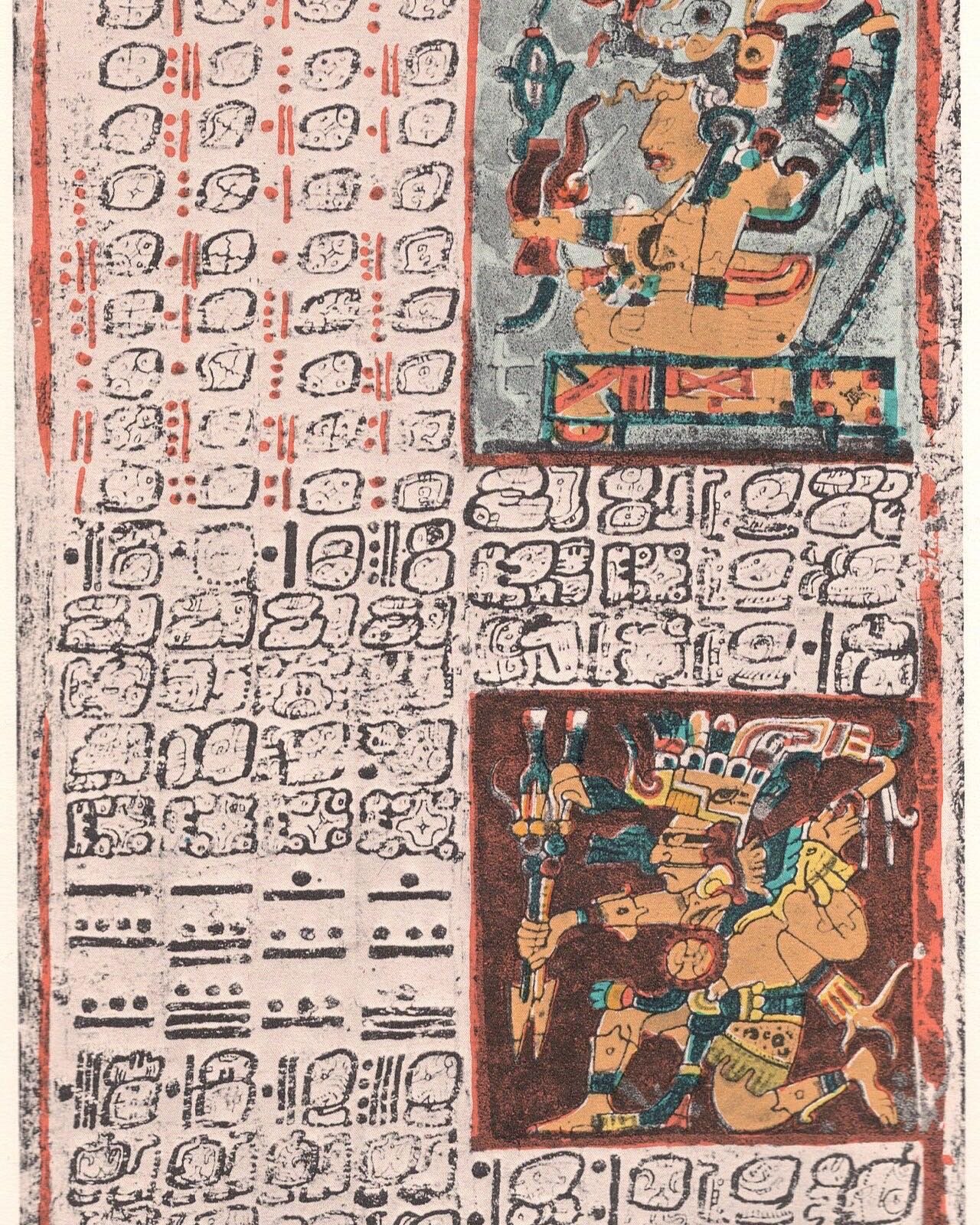
The is 260 days, 13 numbers with 20 day names. The is 365, with a five-day Wayeb’. Together they make a of 18,980 days, 52 Haab’ years. The counts from 3114 BCE; a baktun is 144,000 days. Five Venus cycles of 584 days equal eight Haab’ years exactly. The Dresden eclipse table runs 405 lunar months. None of these is a 26,000-year clock.
A long apprenticeship, and a name
Lidar work in 2023 finds solar alignments consistent with the 260-day count as early as 1100–750 BCE. A painted 7 Deer at San Bartolo, about 300–200 BCE, is the earliest securely dated Maya day-name. Quiriguá Stela C, about 775 CE, records the 3114 BCE creation. Xultun’s painted tables are older than the surviving Dresden book. In 2026 Rossi, Stuart, and Hurst read a signed formula there: Sak Tahn Waax, “White-chested Fox.” Daykeepers in highland Guatemala still keep Chol Q’ij.
Three open questions
The origin of 260 days is unresolved. Linden and Bricker’s 2023 paper on the is a plausible frame for visible planets, not a settled reconstruction. In 2025 Aveni, Justeson, and Bricker tested the claim that large Maya numbers encode and found the arguments invalid. The Maya counted Venus, the Moon, and the k’atun. That is the impressive part.
Two captions that are not in the inscriptions
21 December 2012 completed thirteen baktuns. Tortuguero Monument 6 mentions that future date inside a seventh-century dedication. It does not predict an apocalypse or a universal awakening. NASA’s “dark rift” note is that the claimed galactic alignment was not a unique physical event. A reported Bashar line that the original came from off Earth is tested against genomes in the Maya test lesson, and fails.
Sources
- Smithsonian National Museum of the American Indian. “Living Maya Time.” maya.nmai.si.edu. Accessed 28 October 2026.
- Smithsonian National Museum of the American Indian. “Living Maya Time: the meaning of 2012.” maya.nmai.si.edu. Accessed 28 October 2026.
- Erik Velásquez García, translation. “Quiriguá Stela C, deciphered.” Smithsonian National Museum of the American Indian, undated. Document.
- Smithsonian National Museum of the American Indian. “Living Maya Time: corn and calendar traditions.” maya.nmai.si.edu. Accessed 28 October 2026.
- Sächsische Landesbibliothek – Staats- und Universitätsbibliothek Dresden. “The Dresden Maya Codex.” www.slub-dresden.de. Accessed 28 October 2026.
- Allen J. Christenson, translator (2007). Popol Vuh: The Sacred Book of the Maya. University of Oklahoma Press; research materials at Mesoweb. www.mesoweb.org.
- Miguel León-Portilla (1968 (digital edition)). Tiempo y realidad en el pensamiento maya. Universidad Nacional Autónoma de México, Instituto de Investigaciones Históricas. historicas.unam.mx.
- Alexander Wolfgang Voss (2015). La noción del tiempo en la cultura maya prehispánica. Estudios de Cultura Maya (SciELO México). https://www.scielo.org.mx/scielo.php?pid=S1665-80272015000200004&script=sci_arttext
- Šprajc, I., Inomata, T., and Aveni, A. F. (2023). Origins of Mesoamerican astronomy and calendar: evidence from the Olmec and Maya regions. Science Advances. doi:10.1126/sciadv.abq7675
- Stuart, D., Hurst, H., Beltrán, B., and Saturno, W. (2022). An early Maya calendar record from San Bartolo, Guatemala. Science Advances. doi:10.1126/sciadv.abl9290
- Saturno, W. A., Stuart, D., Aveni, A. F., and Rossi, F. (2012). Ancient Maya astronomical tables from Xultun, Guatemala. Science. doi:10.1126/science.1221444
- Linden, J. H., and Bricker, V. R. (2023). The Maya 819-day count and planetary astronomy. Ancient Mesoamerica. doi:10.1017/S0956536122000323
- Justeson, J., and Lowry, J. (2025). The design and reconstructible history of the Mayan eclipse table of the Dresden Codex. Science Advances. doi:10.1126/sciadv.adt9039
- Rossi, F. D., Stuart, D., and Hurst, H. (2026). The identification and work of an eighth-century Maya mathematician. Antiquity. doi:10.15184/aqy.2026.10378
- Aveni, A. F., Justeson, J., and Bricker, V. R. (2025). Maya astronomy and the precession of the equinoxes. Journal for the History of Astronomy. doi:10.1177/00218286241307930
- The Metropolitan Museum of Art. “Tortuguero Monument 6 and the 2012 story.” www.metmuseum.org. Accessed 28 October 2026.
- NASA. “2012: Shadow of the dark rift.” www.nasa.gov. Accessed 28 October 2026.