
Origin · Chapter 1
Fossils and the braid
What if our species did not come down one line — it came down a braid?
Photograph-like image made for this site. Not a licensed travel photo.
Three teachings date a change to the human body. None agree with each other, and the fossils keep their own clock.
Jebel Irhoud in Morocco, dated in 2017, pushed early to around 300,000 years. Ancient DNA models interacting African populations, not one cradle. Chromosome 2 is a fusion we can still see. Teachings name editors inside that window. None of them reads from the genome.
Jebel Irhoud, and a species that is African
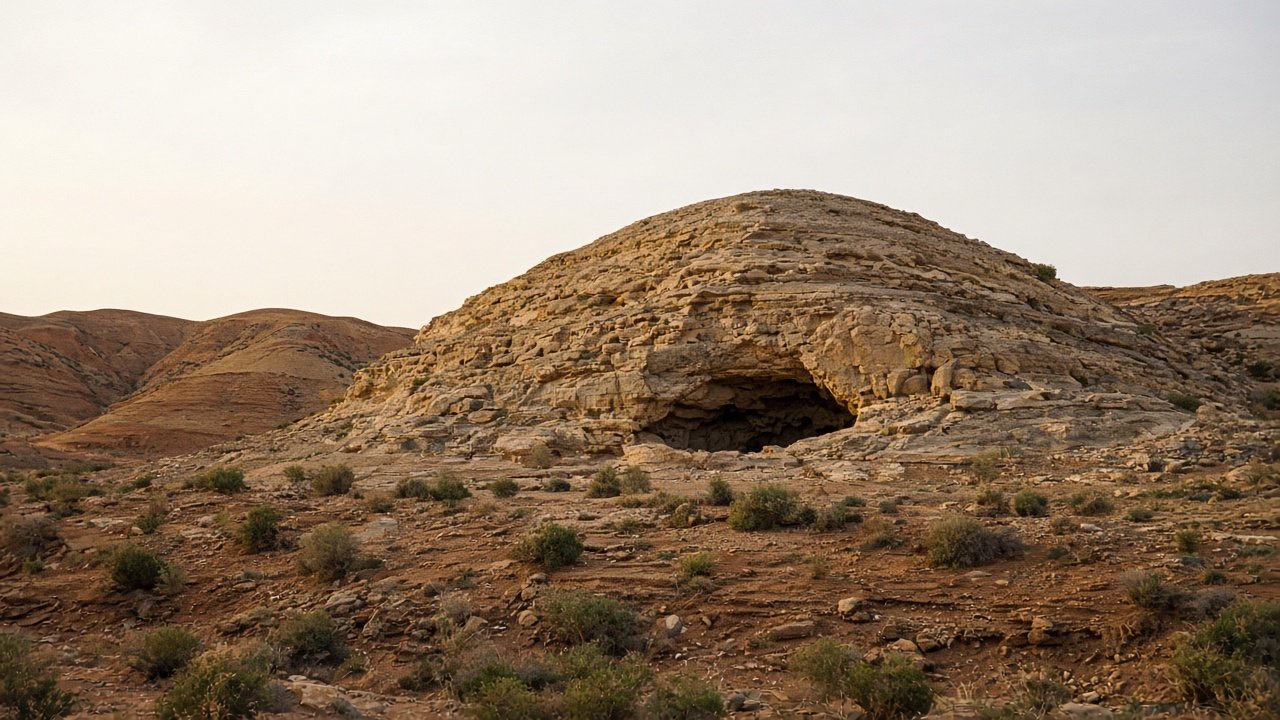
A limestone hill west of Marrakech held skulls that, once redated in 2017, pushed early back to around 300,000 years. Later fossils spread across Africa. The Smithsonian Human Origins Program keeps the running list. This is not a single Garden. It is a continent of overlapping populations, some of which look more “modern” in the face than in the braincase, which is why “the first human” is a bad sentence.
The braid
A 2023 Nature paper by Aaron Ragsdale and colleagues models our ancestry as a weakly structured stem: interacting African populations rather than one isolated cradle that later expanded. Outside Africa, living people carry Neanderthal DNA, and in some regions Denisovan DNA as well. Extinction and interbreeding are both in the record. The picture is a braid, not a ladder.
Chromosome 2
Humans have 23 pairs of chromosomes; other great apes have 24. shows where two ancestral chromosomes joined end to end. The leftover telomere sequence is still visible inside the chromosome; Ijdo and colleagues described it in 1991. That is an earthly history of the karyotype. It is not a donor’s signature. A claim of engineering needs positive evidence — a sequence that does not belong — not an unexplained stretch of DNA, and not a fusion we can already explain.
Where the teachings sit
A transcript attributed to on 19 June 2021 places an alteration of Homo sapiens about 350,000 years ago, after hominids had already evolved here. That sits near the fossil window. , through Lee Carroll, gives Pleiadians a change about 200,000 years ago. gives the a fitting of bodies for minds from about 75,000 years ago. None of those dates is read from a genome. No verified extraterrestrial sequence has been found. The next chapter puts the three clocks in one room. The chapter after that walks Ra’s three episodes — Maldek, Mars, Yahweh — in full English.
Sources
- Smithsonian National Museum of Natural History. “Human Origins Program: Homo sapiens.” humanorigins.si.edu. Accessed 28 October 2026.
- Ragsdale, A. P., et al. (2023). A weakly structured stem for human origins in Africa. Nature. doi:10.1038/s41586-023-06055-y
- IJdo, J. W., et al. (1991). Origin of human chromosome 2: an ancestral telomere-telomere fusion. Proceedings of the National Academy of Sciences. doi:10.1073/pnas.88.20.9051