
History · Chapter 2
Four worlds
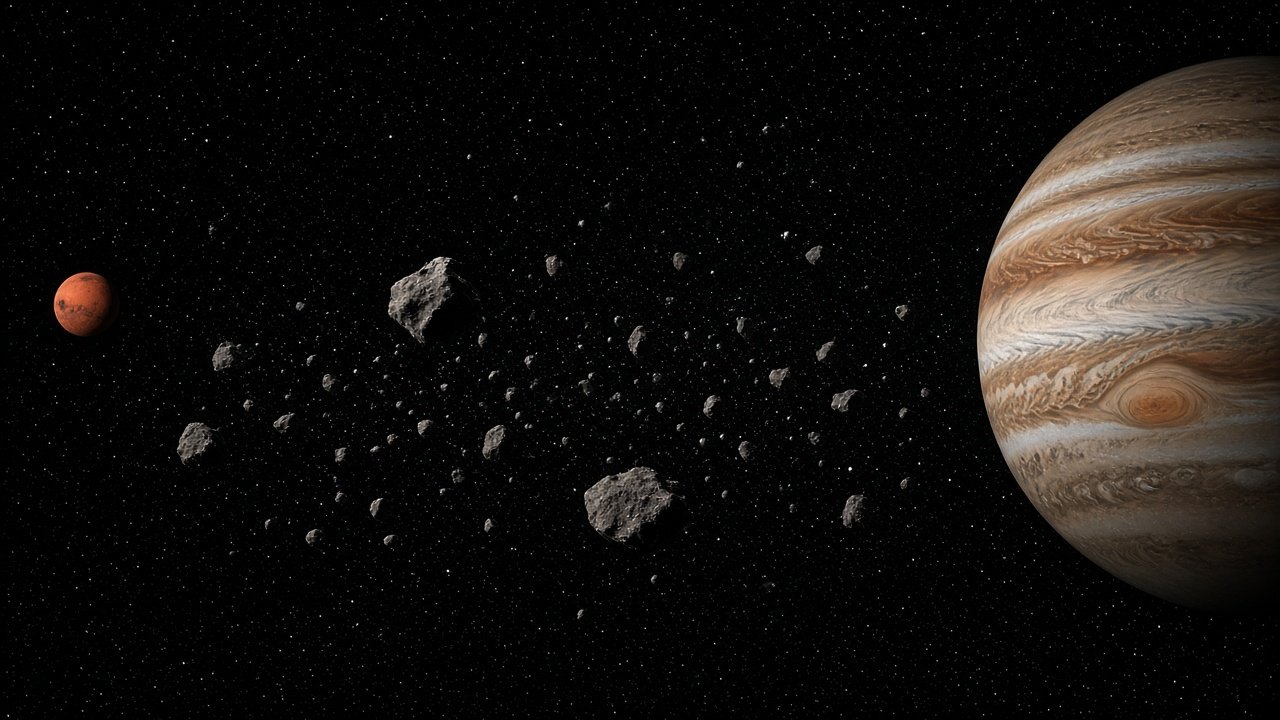
In the Law of One, this species has already lived on Venus, on a world Ra calls Maldek, and on Mars, before the present cycle on Earth. Planetary geology uses a much older clock.
Illustration made for this site. Not a photograph of the claim.
Ra’s Mars collapse sits about 75,000 years ago. The planet’s own record puts the loss of its air and water more than three billion years earlier.
tells a relay: Venus, then a world that became the asteroid belt, then Mars, then Earth. A 2006 Bashar interview, known through a third-party transcript, keeps the sequence and gives Maldek a different death. Geology keeps a much older clock. The idea is one species with a repeated failure. The dates do not survive the planets.
Venus, then Maldek
, in Session 6, places its own third-density life on , long ago, and says those people came to Egypt and South America about 11,000 years ago by thought, not by craft. That is Ra speaking about Ra. NASA’s picture of Venus is a runaway greenhouse with a surface hot enough to melt lead; nothing in the Magellan maps is a city. The two sentences can sit together. One is a being describing a former home. The other is a planet as it is now.
, in Ra, is the world that used to sit where the asteroid belt sits now. Session 10 says it broke by war about 705,000 years ago. Its people, held in a knot of fear after the destruction, were given on Earth about 500,000 years ago as a way through. The name Maldek is Ra’s. It is not a NASA catalogue name, and it is not ’s twelfth planet.
Mars, then Earth

The Martians, Ra says in Sessions 9 and 10, damaged their atmosphere with warlike habits until the planet could not carry third-density life. About 75,000 years ago the moved those minds to Earth and adjusted the bodies available here. That is where Ra starts Earth’s present third-density cycle. The living population, Ra says, is many from , a few from Maldek, and others from many places. In Session 20 Ra is asked whether the Martian influx tipped Earth toward the negative path, and says no.
This is a story of consciousness moved and bodies fitted, not of spaceships landing in Africa. The Origin chapter on Mars, Maldek, and Yahweh walks the same three episodes with more of Session 18. Here the point is the relay: four worlds, one species, one repeated failure.
War, or a passing body
A 15 May 2006 interview attributed to , known through a third-party transcript, keeps the sequence Maldek, then Mars, then Earth. It gives Maldek a different death: a close passage of another body rather than a war. Ra’s version is a warning about choice. Bashar’s reported version is an accident of orbit. Those are not the same sentence. The official recording exists to check the transcript against; this site does not copy either.
When two channelings rhyme on a sequence and disagree on a cause, the first question is whether the later speaker had read the earlier books. The Law of One was in print for more than twenty years before 2006. A shared library is not a second witness. The disagreement is still useful: it shows that “Maldek” is a named claim, not a settled event.
What the planets actually are
Mars really was wet, with a thicker atmosphere. After its magnetic field failed, MAVEN measured the loss of air still under way. The habitable window closed more than three billion years ago. At 75,000 years ago Mars was the cold, dry planet it is now. A 2024 Perseverance sample from Jezero is argued over as a possible microbial biosignature. Nothing built, and no human bone, has been found off Earth. The Face at resolved into a mesa once the photographs improved.
The asteroid belt holds about four percent of the Moon’s mass. NASA’s account is that it never assembled into a planet; Jupiter’s gravity kept the material from coalescing. Four percent of a moon is not the rubble of a world the size of Mars. Ra’s Maldek can still be read as a teaching about war. It does not describe the belt we can weigh.
The idea that cuts hardest is not the dates. It is that “alien” here means cousin: a population that already lived in this system and already failed a planet. Geology agrees this system had more than one world that could carry life. The clocks are off by four to five orders of magnitude, which is not a rounding error. Unlike Atlantis, the planets are still here to sample.
Sources
- Ra. The Law of One, Session 6. L/L Research, 24 January 1981. llresearch.org.
- Ra. The Law of One, Session 9, 9.6–9.13. L/L Research, 27 January 1981. llresearch.org.
- Ra. The Law of One, Session 10, 10.1–10.6. L/L Research, 27 January 1981. llresearch.org.
- Ra. The Law of One, Session 20, 20.18–20.20. L/L Research, 9 February 1981. llresearch.org.
- Bashar, channeled by Darryl Anka. “An Interview with Bashar.” Bashar Communications, 15 May 2006. tv.bashar.org.
- Bashar, channeled by Darryl Anka. “Interdimensional Portals.” Bashar Communications, undated in the catalogue. tv.bashar.org.
- NASA Science. “Mars: facts.” science.nasa.gov. Accessed 28 October 2026.
- Jakosky, B. M., et al. (2017). Mars’ atmospheric history derived from upper-atmosphere measurements of 38Ar/36Ar. Science. doi:10.1126/science.aai7721
- NASA Science. “Asteroids: facts.” science.nasa.gov. Accessed 28 October 2026.
- NASA / JPL. “Mars Global Surveyor and Mars Reconnaissance Orbiter imaging of the Cydonia mesa.” science.nasa.gov. Accessed 28 October 2026.
- Hurowitz, J. A., et al. (2025). Redox-driven mineral and organic associations in Jezero Crater, Mars. Nature. doi:10.1038/s41586-025-09413-0
- NASA Science. “Venus: facts.” science.nasa.gov. Accessed 28 October 2026.