
History · Chapter 8
Early stone
Göbekli Tepe and Karahan Tepe were raised by hunter-gatherers around 9600 BCE, before farming in the region. The skill is human. A visiting teacher is an extra hypothesis, not a requirement of the stones.
Photograph-like image made for this site. Not a licensed travel photo.
People tell this stretch of history with different dates. A dotted line means the same event, a different year.
and Karahan Tepe are dated. Hunter-gatherers built them. reads a teacher behind the skill. The archaeology does not need that step unless something else demands it. A Bashar catalogue title names the site; the recording holds whatever was said.
Göbekli Tepe
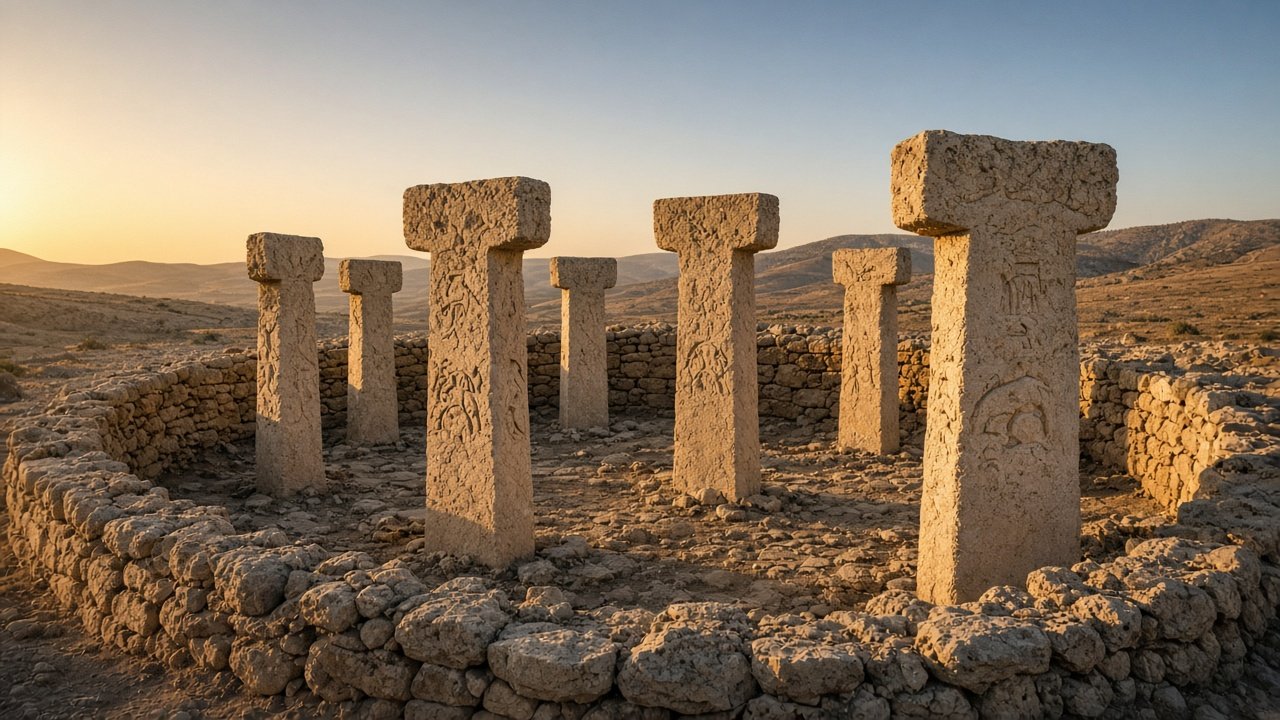
On a ridge north of Şanlıurfa, T-shaped limestone pillars up to about ten tons stand in ring enclosures, carved with foxes, boars, birds, and snakes, and later buried on purpose. UNESCO lists the oldest layers around 9600 BCE. The communities who set those stones hunted and gathered. Farming in the region comes after, not before. That reversal is the surprise Klaus Schmidt spent a career making public: gathering places before fields.
The skill is real. Planning a ring, moving ten tons, carving an animal in relief, and then filling the whole thing in is not the work of people who had just learned to stack rocks. It is also not, by itself, the work of a visiting engineer. Collective labour, transmitted skill, and a lot of time are sufficient unless a different kind of evidence shows up — metal, writing, a tool kit that does not belong.
Karahan Tepe
About an hour east, Karahan Tepe cuts pillars from the living rock and holds a chamber of carved phalluses. The excavator, Necmi Karul, speaking on camera in Ancient Apocalypse, is clear that the builders were still hunter-gatherers. The site is as old as Göbekli, or older in some cuts. It is the same argument, one valley over: people gathered, carved, and organised before they farmed.
What Hancock and Bashar add
reads both sites as a transfer. In his telling, people who already knew megaliths — survivors of a broken Ice Age culture — organised the locals. That is a journalist’s step, and he says so. The archaeology does not require it. The stones, the dates, and the animal art are all accounted for by the people whose camps and tools sit in the same landscape.
The Bashar session A Step Along the Way lists Göbekli Tepe among its questions, beside Anunnaki monuments and Giza. A catalogue title tells you the subject was asked. It does not tell you the answer. The hold that. Until someone cites the recording in their own words, Göbekli on this site is a dated human place, with a later reading attached, and a teaching that has not yet been quoted.
Sources
- UNESCO World Heritage Centre. “Göbekli Tepe.” whc.unesco.org. Accessed 28 October 2026.
- Ancient Apocalypse, Season 1, Episode 5, Necmi Karul on camera. Graham Hancock (presenter). Netflix, 2022. Summarised, not transcribed.
- Bashar, channeled by Darryl Anka. “A Step Along the Way.” Bashar Communications, 2021. tv.bashar.org.