
History · Chapter 7
Hancock’s Ice Age case
Ice Age sea levels and the Younger Dryas cold snap are measured facts. Hancock’s further step — a destroyed advanced culture whose survivors taught the rest — is his reading of the gap, not a dated city.
Illustration made for this site. Not a photograph of the claim.
Where the two lanes meet, archaeology and the series agree. Where a dotted line runs, the claimed age rests on sea level, star alignment, or disputed cores, not on a dated layer.
The sea was about 120 metres lower. A sharp cold snap at 12,800 years is real. ’s step is survivors who taught the rest. No city, no writing, no trash of that culture has been produced. The next two chapters take his sites one by one.
A lower sea
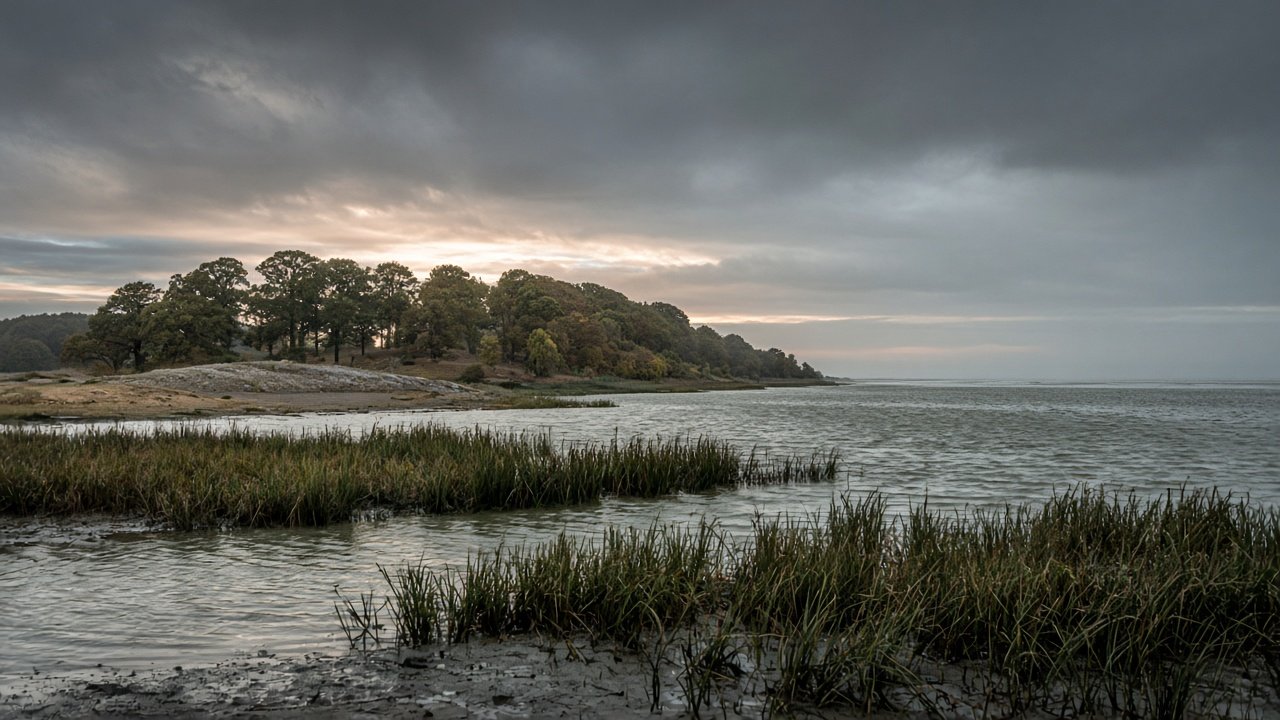
Around 20,000 years ago, at the coldest point of the last glaciation, the sea stood roughly 120 metres lower than it does now. Sundaland joined Java to the mainland. Malta stood on a land bridge. The Bahama Bank was one island. ’s series uses a figure of about ten million square miles of former land now under water. Those shelves are real, and they are mostly unsurveyed. Incomplete maps are a fact. They are not yet a civilisation.
The Younger Dryas
From about 12,800 to 11,600 years ago the North Atlantic world snapped back into cold. American megafauna disappear in the same window. Firestone and colleagues, in 2007, read a “black mat” layer, melted glass, and a platinum spike as the trace of comet fragments. That is the impact hypothesis. A 2023 review in Earth-Science Reviews, led by Vance Holliday, calls the hypothesis refuted. The cold snap itself is not in dispute. The comet is the argument.
takes the impact as the blow that ended an advanced Ice Age culture. Archaeology takes the same centuries as a hard climate and a rising sea, with hunter-gatherers on both sides of the break. The next two chapters are where those two readings meet particular stones.
Watch Cataclysm and Rebirth on Netflix. The series stays with the publisher.
Survivors, or a gap
’s own step — he calls himself a journalist, not an archaeologist — is that an advanced culture shared the planet with hunter-gatherers, was broken at the Younger Dryas, and that its survivors taught farming, stone, and the sky to those who remained. Flood myths, the Apkallu of Mesopotamia, Quetzalcoatl, and Viracocha are filed by him as memory of that teaching. Plato’s 9,000 years before Solon is his literary anchor.
An Ice Age civilisation would leave tools, metal, pottery, and middens somewhere above water too. None has been produced. Hancock’s reply is that the coasts are drowned and the myths are the archive. That is a coherent reading of a gap. It is not a dated city. The sites he visits are sorted, one by one, next.
Sources
- Ancient Apocalypse, Season 1. Graham Hancock (presenter). Netflix, 2022. Summarised, not transcribed.
- Ancient Apocalypse, Season 2: The Americas. Graham Hancock (presenter). Netflix, 2024. Summarised, not transcribed.
- Firestone, R. B., et al. (2007). Evidence for an extraterrestrial impact 12,900 years ago that contributed to the megafaunal extinctions and the Younger Dryas cooling. Proceedings of the National Academy of Sciences. doi:10.1073/pnas.0706977104
- Holliday, V. T., et al. (2023). Comprehensive refutation of the Younger Dryas Impact Hypothesis (YDIH). Earth-Science Reviews. doi:10.1016/j.earscirev.2023.104502
- Plato (fourth century BCE). Timaeus and Critias. Perseus Digital Library, Tufts University (English text). www.perseus.tufts.edu.