
Aliens · Chapter 11
Before the flying saucer
People described unfamiliar presences, journeys to other worlds and remarkable things in the sky long before the expression “flying saucer” became familiar. Some surviving accounts resemble parts of modern encounter narratives closely enough to deserve comparison. Others become similar only after a translator, illustrator or modern commentator supplies a technological explanation.
Illustration made for this site. Not a photograph of the claim.
Older sky reports, otherworld encounters and the search for continuity.
Reviewed 30 October 2026.
1. The question existed before its modern name
People described unfamiliar presences, journeys to other worlds and remarkable things in the sky long before the expression “flying saucer” became familiar. Some surviving accounts resemble parts of modern encounter narratives closely enough to deserve comparison. Others become similar only after a translator, illustrator or modern commentator supplies a technological explanation.
This history matters to the central question of the course. If encounters with another intelligence occur, their earlier descriptions might reflect the languages and expectations of earlier societies. But the same pattern could also arise because human perception, imagination and storytelling have recurring features. A shared experience and a shared external visitor are different conclusions.
We will follow three histories: unusual sky reports, encounters with apparently autonomous beings, and traditions of knowledge received from elsewhere. They sometimes intersect. They should not be combined merely because each contains something extraordinary.
The aim is to recover what the older source actually contributes. Its religious or mythic setting is part of the evidence. Removing that setting can make the text look more modern while making the historical account less accurate.
2. Nuremberg, 1561: the surviving report
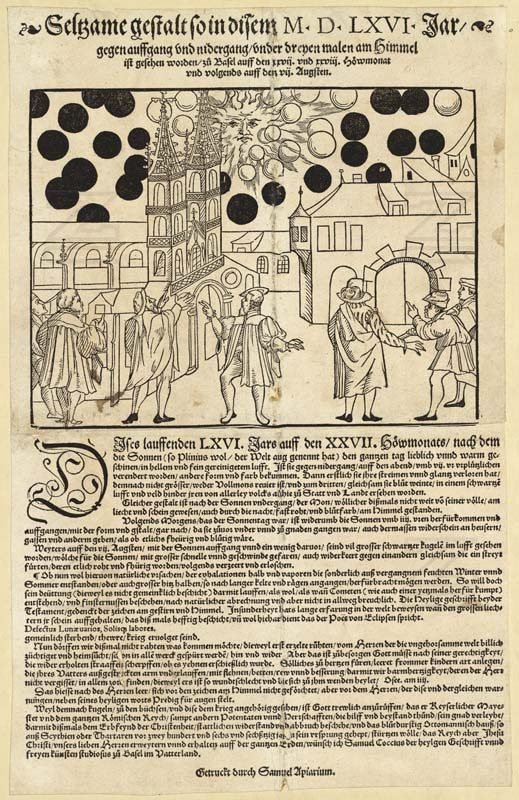
Hans Glaser’s illustrated broadsheet describes a celestial display over Nuremberg on 14 April 1561. Copies survive in the Zentralbibliothek Zürich’s collections. The archive identifies a contemporary coloured woodcut with printed text and a religious interpretation of the event. We therefore have an inspectable historical publication, rather than only an internet story about one. [1]
The German transcription describes a dawn display around the Sun: coloured round forms, crosses, tube-like forms and apparent movement or conflict, followed by a dark elongated shape. It frames the spectacle as a warning calling for repentance. Those are the source’s reported forms and interpretation; “space battle” is a modern identification added to them. [2]
Two dates need to remain distinct: the alleged event in 1561 and the production of a modern image, translation or retelling. A brightly enhanced reproduction does not improve the original observations. Several copies of the same broadsheet do not become several independent accounts.
The text’s reference to many observers is important, but it is still a statement within one publication. We do not possess a corresponding set of individually recorded interviews in the sources used here. Nor is the woodcut a sequence of photographs that can supply trajectories, distance or speed.
This leaves a real historical question. What combination of observation, interpretation and illustration produced this particular account? It remains worth asking without deciding that each drawn shape is a vehicle.

3. A comparison close to home: another Glaser sky publication
A separate Glaser broadsheet, catalogued with an uncertain publication date of 1556, concerns a solar appearance over Nuremberg on 12 May of that year. The archive describes it as a halo around the Sun and notes its interpretation as a divine warning. This is a different item from the famous April 1561 report. [3]
The comparison is valuable because it shows a publication setting in which an unusual sky appearance could be presented as a meaningful sign. A religious interpretation need not mean that nothing was observed. Equally, the observation need not be a technological object simply because its depiction looks unusual to a present-day reader.
The halo description does not settle the 1561 case. Importing the identification of one event into another would repeat the same error as importing an alien explanation. Instead, it gives us a nearby comparison for vocabulary, visual conventions and the relation between natural appearance and religious meaning.
A convincing physical reconstruction of the 1561 display would have to fit its own reported time, direction, geometry and sequence. The surviving text may not preserve enough information for one unique reconstruction. Uncertainty at that point is a limitation of the record, rather than a positive identification of its cause.
4. Magonia: cloud ships in a medieval dispute
In the ninth century, Agobard of Lyons wrote against beliefs about human storm-makers and a region called Magonia. In the translated text, he describes people believing that ships came through the clouds to collect crops damaged by storms. He also recounts a group holding four people accused of having come from those ships. Agobard contests the belief; he does not present himself as a witness to a landing. [4]
The distinction changes the historical question. The passage establishes that an aerial-visitor story circulated and that it could have consequences for accused people. It does not establish where those people came from or that a cloud ship was present.
It also complicates an easy division between ancient belief and modern disbelief. Agobard himself was an early critic of the account, using the intellectual and religious resources available to him. There was already disagreement within the culture that preserved the story.
For a modern reader, the resemblance is striking: a remote place, aerial transport and alleged visitors among ordinary people. But the cargo, economic exchange and storm-making belong to a particular social world. Preserve them. A comparison becomes more informative when it includes the unfamiliar differences as well as the recognisable outline.
5. Fairy encounters: a story about birth and altered sight
W. Y. Evans-Wentz’s 1911 The Fairy-Faith in Celtic Countries contains an Irish midwife narrative recorded in its evidence-gathering section. A nurse accompanies a strange man to an unfamiliar place to assist at a birth. After touching one eye with water used there, she can recognise some of the women later at a fair. A fairy woman discovers how the nurse sees them and removes her sight in that eye. [5]
Several details invite comparison with later encounter literature: being taken to another setting, involvement in reproduction, perception that other people do not share, and an apparent restriction on what may be seen. The pattern is more specific than simply “someone met a strange being”.
But its access history matters. The source preserves a narrated story; it is not an interview with the nurse, a medical examination of her eye or a dated record of the birth. The story can be studied as a structured account without upgrading it into those missing records.
The differences are equally useful. Its setting includes a horse, a castle, a basin of water and a local fair. A retelling that substitutes a craft, a laboratory and a technological implant may make the resemblance stronger by altering the evidence it claims to explain.
That is precisely where comparison should slow down. Is a recurrent experience being translated into successive cultural forms, or are modern readers rewriting an older tale into their own form?
6. The otherworld was not one category
The same Evans-Wentz section records accounts connecting fairies with deceased relatives and healing knowledge. In one narrative, an allegedly drowned brother communicates knowledge of an herb; another concerns a deceased daughter appearing to her grieving mother. Whatever one concludes about their causes, these accounts show that the collected material includes bereavement, kinship and practical help as well as frightening encounters. [5]
A modern alien interpretation can lose this diversity. The source’s “otherworld” may bring together categories that a present-day researcher keeps apart: the dead, local presences, hidden people and powerful beings. We cannot assume that every narrator meant a biological population living on another planet.
Time also needs careful handling. When comparing stories of changed duration or return from an otherworld, first ask which edition and passage actually preserve the discrepancy. “Lost time” is a research category, not a phrase that should be inserted wherever a narrative contains a journey.
There are several different possibilities: elapsed time differs between worlds; the traveller cannot remember an interval; a later narrator compresses a sequence; or an editor introduces the apparent discrepancy. Those differences lead to different explanations.
The historical material is richer when allowed to retain its own categories. Its value does not depend on making every account describe the same kind of encounter.
7. Ezekiel: wheels inside a religious vision
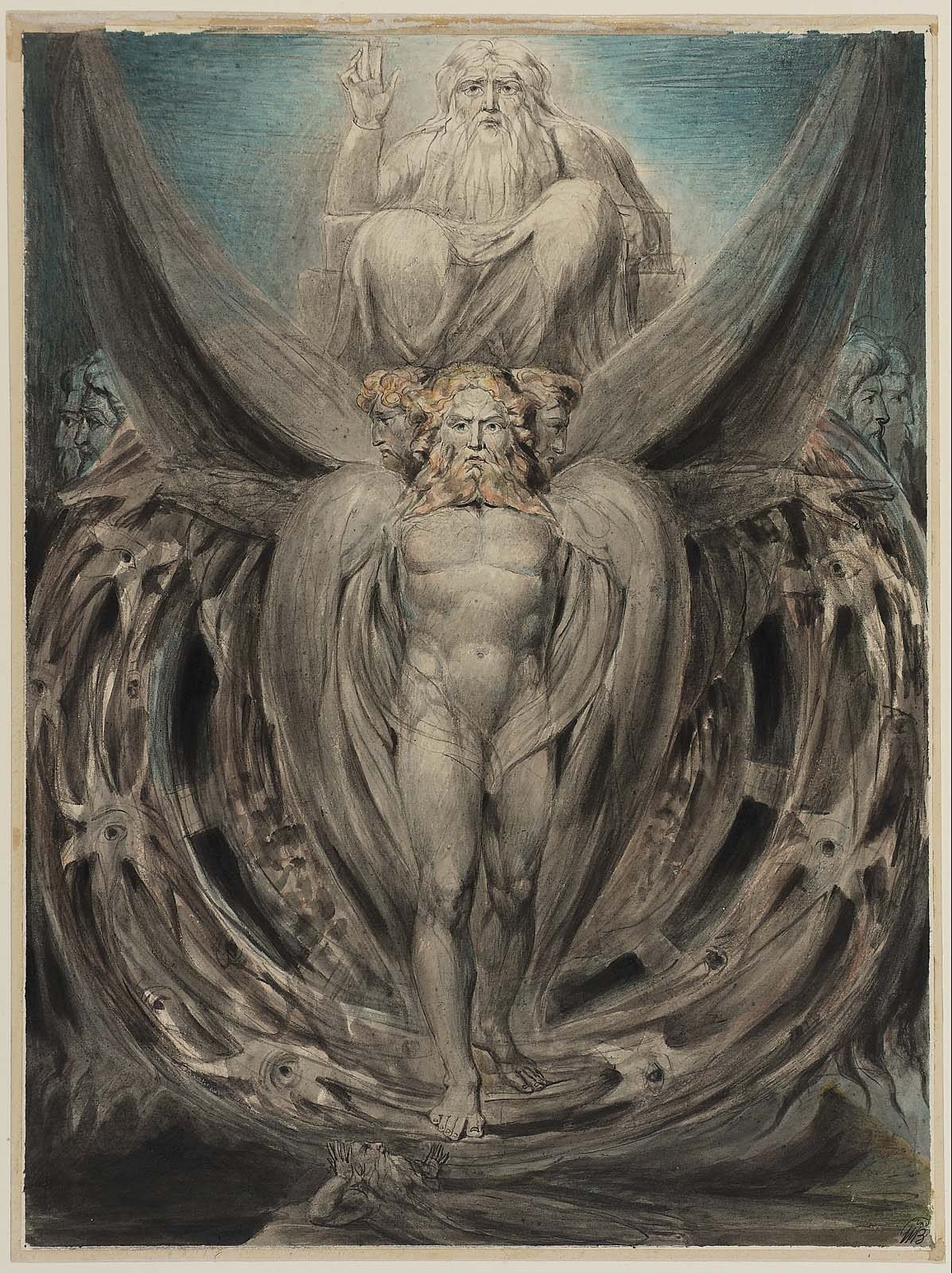
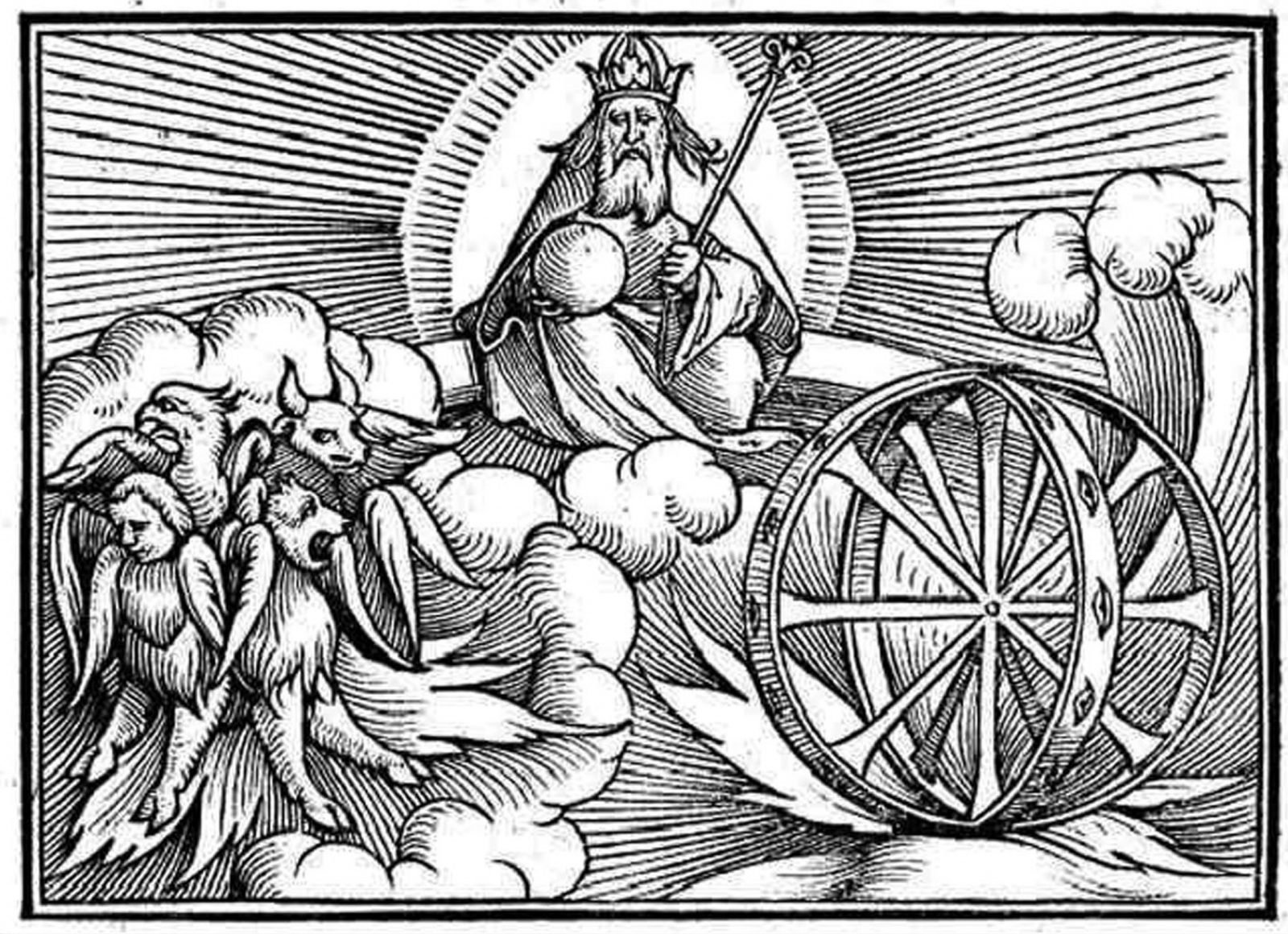
Ezekiel chapter 1 is often brought into ancient-astronaut discussions because it describes remarkable living beings, wheels and coordinated movement. The chapter opens as a vision and culminates in a throne and an appearance associated with divine glory. The text’s own frame belongs alongside its visually striking details. [6]
An interpreter can ask whether a real encounter underlies that imagery. The text does not forbid inquiry. But “wheel” is not already an identification of a landing mechanism, and a vivid description is not a set of engineering measurements.
The source contains a relationship among the beings, movement, spirit and divine presence. A reconstruction that keeps the wheels while discarding the rest may be explaining a selected fragment rather than the whole account. Conversely, recognising a religious form does not prove that the narrator experienced nothing beyond an inherited story.
A serious comparison therefore keeps several questions open: what does the passage say, what kind of claim does it make, how has it been interpreted, and what would support a particular physical reconstruction? The answer to one need not settle all the others.
This is also where the distinction between meaningfulness and identification matters. A vision can be central to a religious life while remaining insufficient to establish an extraterrestrial visitor’s origin.

8. Pushpaka and the history of an alleged flight manual
The Ramayana contains aerial transport. In Griffith’s translation, book VI, canto 123, the Pushpaka vehicle can carry Rama and his companions. This is a genuine feature of the epic, available for direct reading. It should neither be erased from the text nor silently turned into an independently documented aircraft. [7]
A second work frequently enters the discussion: the Vymanika Shastra. The connection is often made through the shared subject of flight, but these texts have different histories. A 1974 investigation by Indian Institute of Science researchers examined this work’s provenance and engineering content. They concluded that it could not be dated earlier than 1904 and found its proposed aircraft technically unviable as described. Their paper also distinguishes published versions and the later appearance of drawings. [8]
This is a particularly useful example of why transmission matters. An old epic can contain a flying vehicle while a much later technical-looking work receives an unsupported ancient date. Correcting the date of the latter does not remove the former from the historical imagination.
Nor does the epic establish that the later drawings reproduce its machinery. A claim of technological continuity needs an actual chain between texts, designs, builders and operation.
What would move the inquiry forward is an authenticated early engineering document, material evidence or a reproducible mechanism with a separately established history. A modern design merely labelled ancient would leave that historical question unanswered.


9. Seven Sisters: a named living tradition
The National Museum of Australia’s Songlines: Tracking the Seven Sisters project provides a more grounded approach than collecting anonymous statements that “Indigenous people knew”. Its public materials identify leadership by senior custodians and an initiative originating with Anangu elders. The 2017 panel discusses the relationship among ancestral journeys, landscape, Orion and the Pleiades. [9]
This is a substantial connection between earthly life and the sky, presented through named people and a specific cultural project. Its significance exceeds the question of whether it resembles a modern alien account.
A shared reference to the Pleiades is nevertheless worth comparing. The same stars can be visible to different societies and become a focus for stories. A modern channelled source using that astronomical name is therefore not automatically independent confirmation of an ancient genetic intervention.
To establish a closer overlap, identify the precise shared proposition: named visitors, a journey, a biological act, a transmitted skill or an ethical teaching. Then establish where each detail occurs in the public source and how its custodians explain it.
This also prevents a false claim of universality. One public Seven Sisters presentation cannot speak for every Aboriginal nation, every Indigenous tradition or every restricted teaching. Comparison should begin with the account actually shared, rather than a larger story supplied by an outsider.
A round boat in Japan and the custodians of Wandjina traditions
Japan’s National Archives presents manuscripts recounting an alleged 1803 arrival of a round boat and an unfamiliar woman on the Hitachi coast. The Utsurobune story is worth comparing because its vessel, visitor and unusual writing can resemble motifs in modern encounter narratives. Its recorded setting is maritime: a boat coming ashore is not a documented flight. The alleged event’s date must also be distinguished from the dates and relationships of the manuscripts preserving it. [14]
The value of this example lies partly in its ambiguity. Did later readers impose spacecraft expectations on a nautical curiosity, or does the story preserve an unusual encounter? Compare the earliest wording and images before answering. A visual resemblance alone cannot decide the vessel’s origin.
For Wandjina traditions, begin with the people whose heritage is being discussed. Mowanjum Aboriginal Art and Culture Centre describes Wandjina as sacred spiritual and creative presences within the traditions of the Worrorra, Ngarinyin and Wunambal peoples. That public self-description takes priority over an outsider’s resemblance-based alien label. [15]
A comparative chapter can discuss why modern UFO writers recognise familiar shapes while also explaining that the custodians’ account is a living religious and cultural context. Reproducing sacred imagery or extending an interpretation requires attention to the appropriate community’s permissions. The existence of an old image does not give an outsider authority to redefine its meaning.

National Archives of Japan. Historical accounts of an unfamiliar woman and a round boat. The page is a source locator. A manuscript image is not reproduced here.
10. Vallée: what if the changing forms are part of the phenomenon?
Jacques Vallée’s Passport to Magonia (1969) makes comparison across folklore and modern encounter accounts central to the inquiry. His later Wonders in the Sky, with Chris Aubeck, extends the historical range. The author’s descriptions emphasise recurring accounts and changes in the cultural form of visitors. [10]
This invites a serious possibility: the apparent discontinuity between a fairy encounter and a technological encounter may not be decisive. An unfamiliar intelligence might be encountered or understood through the forms available to the observer. Another possibility is that similar human experiences repeatedly acquire locally persuasive explanations.
The first hypothesis does not follow merely because the second feels incomplete. Each needs observations that distinguish it. For example, could an encounter convey accurate information inaccessible to the witness? Do independent records preserve a distinctive sequence before the later storyteller could know it? Does an allegedly adaptive appearance produce any prediction beyond retrospective similarity?
Vallée’s comparative move is therefore most useful as a widening of the problem. It encourages investigation beyond a simple inventory of spacecraft. It does not remove the need to verify each historical account or identify where a compiler relied on an already circulating story.
11. Hancock and Pasulka: experience, interpretation and culture
In his 2005 interview about Supernatural, Hancock explicitly compares spirits encountered in shamanic settings, fairies and elves, and present-day alien encounters. He also discusses an experience of his own under altered awareness and proposes that the brain might mediate access to a wider reality. These are important statements of his position, rather than interpretations assigned to him by a later commentator. [11]
The bridge to the user’s question is direct: yes, Hancock investigates overlaps of precisely this kind. His proposal concerns the reality-status of encounters as well as their cultural expression. His separate lost-civilisation argument gives a prominent role to earlier humans, rather than requiring extraterrestrial builders. [12]
D. W. Pasulka approaches the subject through the study of religion and ethnography. Her description of American Cosmic discusses interviews with scientists and professionals, the interpretation of unusual experiences and media’s role in shaping belief. [13]
Together these approaches identify two matters that should remain in view: the experience can be consequential to the person, and its explanation develops within a social world. Studying that social world does not by itself settle the experience’s ultimate source.
A persuasive investigation can take witnesses seriously while asking how an image, teaching or expectation entered their interpretation. It can also examine an external-intelligence explanation without treating personal certainty as independent evidence of origin.
12. What survives the comparison?
| Recurring feature | Historical example used here | What remains to be established |
|---|---|---|
| Remarkable forms in the sky | Glaser’s 1561 broadsheet | A physical reconstruction and identification |
| Aerial visitors from elsewhere | Agobard’s account of Magonia beliefs | Whether the alleged visitors or ships existed |
| Birth and restricted perception | Evans-Wentz’s midwife narrative | An independently documented event and its cause |
| Beings, wheels and coordinated movement | Ezekiel’s vision | Whether a proposed physical model fits the complete text |
| Aerial transport | Pushpaka in the Ramayana | Historical machinery beyond the epic narrative |
| Sky, ancestry and landscape | Public Seven Sisters presentation | Any specific connection to a modern intervention claim |
The strongest conclusion is that the modern subject belongs within a longer human history of reported encounters and otherworld narratives. Some motifs predate twentieth-century alien culture. It would be mistaken to assume that every resemblance was invented after modern science fiction.
The further conclusion—that all these sources record one continuing external intelligence—is not established by the comparisons made here. The accounts differ in setting, access, function and content. Some preserve observations, some beliefs about others, some narrated traditions and some visionary experiences.
That diversity may itself be important. It could indicate several causes, a changing human interpretation, or a phenomenon more complex than one category of visitor. The next step is to compare specific details and source histories, preserving both the correspondences and the disagreements.
Questions for study
- Which apparent overlap becomes stronger when the original text is read? Which becomes weaker?
- What evidence distinguishes an early motif from a later technological reinterpretation?
- How could a common external phenomenon and a common human experiential pattern be tested differently?
- What would a tradition’s own custodians add that a modern compilation might miss?
Next: Chapter 12 · Ancient teachers and human origins.
References and source notes
The references distinguish a witness’s statement, an investigator’s assessment and the chapter’s own analysis. An official host authenticates a document’s provenance; it does not automatically establish every assertion within it. URLs were checked or their indexed source text consulted during this review.
Hans Glaser (1561), [Himmelserscheinung über Nürnberg vom 14. April 1561], Zentralbibliothek Zürich, PAS II 1/12; additional copy PAS II 12/60.
https://www.e-manuscripta.ch/zuzneb/content/titleinfo/2723858
https://doi.org/10.7891/e-manuscripta-91897
https://doi.org/10.7891/e-manuscripta-91896
Locator: Catalogue description, date and provenance; companion transcription link supplied in the next reference. Source type: Contemporary illustrated broadsheet held in a public historical collection. Use and limits: Establishes a surviving publication, not a set of separately preserved witness depositions. Archive metadata was consulted; no independent reconstruction of the sky display is claimed.
Hans Glaser broadsheet, German transcription reproduced with the image on Wikimedia Commons.
Locator: Description field: original-language text beginning with 14 April and the time between four and five, followed by forms, movement and religious interpretation. Source type: Transcription accompanying a reproduction of a primary text. Use and limits: The original-language transcription is used for a short paraphrase. The modern retouched image is not treated as an unmodified original or as a photograph. A critical diplomatic transcription remains desirable.
Hans Glaser (1556?), Ein vngewonlich gesicht / an der Sonnen erschinen, Zentralbibliothek Zürich, PAS II 2/11.
https://www.e-manuscripta.ch/zuzneb/content/titleinfo/2725204
https://doi.org/10.7891/e-manuscripta-92168
Locator: Catalogue description: solar halo over Nuremberg on 12 May 1556 and interpretation as a divine warning. Source type: Historical broadsheet and modern archival description. Use and limits: The halo identification is the archive’s description of this separate item. It is not a demonstrated identification of the April 1561 event.
Agobard of Lyons (ninth century), On Hail and Thunder, translated at the Internet Medieval Sourcebook, Fordham University.
https://sourcebooks.web.fordham.edu/source/Agobard-OnHailandThunder.asp
Locator: Sections I–II: storm-makers, Magonia, cloud ships and the accused captives. Translation/source credit at the foot of the page. Source type: Primary medieval argument in English translation. Use and limits: Agobard reports and contests a belief. His account must not be presented as his own observation of a landing or as his endorsement of the accused people’s alleged origin.
W. Y. Evans-Wentz (1911), The Fairy-Faith in Celtic Countries, chapter II, “Taking of Evidence: II. In Ireland”.
https://sacred-texts.com/neu/celt/ffcc/ffcc121.htm
Locator: “The Irish Legend of the Dead” and “A Midwife Story”, printed pp. 53–54; follow the page labels in the digital text. Source type: Original folklore collection, including attributed oral accounts, reproduced online. Use and limits: Evidence for recorded accounts and the collector’s approach. The midwife narrative is a reported story, not a direct interview with its nurse or a contemporary medical record. Collector endorsements are not adopted as independent verification.
Book of Ezekiel, chapter 1, especially verses 1–3, 4–21 and 26–28; Sefaria Hebrew text and English translation.
https://www.sefaria.org/Ezekiel.1.1?lang2=en&with=all
https://www.sefaria.org/Ezekiel.1?lang2=en&with=Commentary
Locator: Opening vision; living beings and wheels; final throne and divine-glory description. Source type: Primary scriptural text accessed through indexed translation excerpts and the reading interface. Use and limits: Used as a religious vision in its own narrative setting. A spacecraft identification would be a later interpretation. The interface did not expose the complete chapter as plain text during retrieval; no translation comparison is claimed.
Valmiki, Ramayana, Ralph T. H. Griffith translation (1870–1874), book VI, canto CXXIII, “The Magic Car”.
https://www.gutenberg.org/files/24869/24869-h/24869-h.html
https://sacred-texts.com/hin/rama/ry494.htm
Locator: Book VI, canto 123, Pushpak / Pushpaka passage; canto numbering and spelling follow Griffith’s edition. Source type: Primary epic in a nineteenth-century English verse translation. Use and limits: Establishes aerial transport within the epic narrative. The translation’s English technological vocabulary is not an ancient engineering specification; no critical Sanskrit collation is claimed.
H. S. Mukunda, S. M. Deshpande, H. R. Nagendra, A. Prabhu and S. P. Govindaraju (1974), “A Critical Study of the Work Vymanika Shastra”, Scientific Opinion, pp. 5–12.
Locator: Summary and section 1 on provenance/dating; later technical analysis and conclusions. Eight-page author-hosted reproduction. Source type: Original historical investigation and engineering analysis by Indian Institute of Science researchers. Use and limits: Their findings concern this particular work and its proposed aircraft. They are not an adjudication of every Sanskrit aerial narrative or every possibility of ancient technology.
National Museum of Australia (2017), “Songlines: the foundational Australian story”, panel transcript, 16 November; Songlines: Tracking the Seven Sisters exhibition.
https://www.nma.gov.au/exhibitions/songlines
Locator: Project’s initiation and leadership by elders/custodians; discussion of Seven Sisters, landscape, Pleiades and Orion. Source type: Public cultural presentation involving Indigenous speakers and a custodian-led exhibition. Use and limits: Used for this named public presentation. It does not license a universal claim about Indigenous beliefs, date every element of a tradition, or establish a modern Pleiadian intervention narrative.
Jacques Vallée, author’s research catalogue: Passport to Magonia (1969) and Wonders in the Sky, with Chris Aubeck (2010).
https://www.jacquesvallee.net/research/
Locator: Entries for the two books, especially the historical comparison and changing cultural forms. Source type: Author-hosted descriptions of original comparative research. Use and limits: Used for the research approach, not as a substitute for auditing every historical case in either book. Publicity superlatives and aggregate claims are not adopted as findings.
Greg Taylor / Graham Hancock (2005), “The Supernatural World of Graham Hancock”, article and interview first published in Sub Rosa, October; reproduced on Hancock’s website.
https://grahamhancock.com/the-supernatural-world-of-graham-hancock/
Locator: Interview exchanges on spirits, fairies and aliens; altered awareness; the receiver hypothesis. Source type: Named author’s firsthand explanation of his argument, alongside the interviewer’s article. Use and limits: The text distinguishes Hancock’s replies from Taylor’s summaries. Similarity and the receiver model remain arguments, not demonstrated external identification. Unrelated scientific and historical claims in the interview are not adopted.
Graham Hancock (2016), “Ancient Aliens or a Lost Civilization?”, 11 May.
https://grahamhancock.com/49103-2/
Locator: Opening paragraphs distinguishing his lost-human-civilisation explanation from ancient-astronaut interpretations. Source type: Author’s own public position. Use and limits: Supports the distinction between Hancock’s two lines of inquiry. It is not archaeological confirmation of the proposed lost civilisation.
D. W. Pasulka, author’s book descriptions: American Cosmic: UFOs, Religion, and Technology (2019) and Encounters (2023).
Locator: American Cosmic entry: ethnographic study, scientist/professional participants, interpretation and media. Source type: Author-hosted description of original ethnographic research. Use and limits: Used for the scope and questions of the study, not a full audit of its interviews or as proof that an alleged recovered object has an extraterrestrial origin. Marketing statistics are not adopted here.
National Archives of Japan, Utsurobune exhibition material
https://www.archives.go.jp/exhibition/jousetsu_08_09.html
Locator: Descriptions of Enkaikibun and Hirokata Zuihitsu accounts of the alleged 1803 event. Use and limits: Japanese archival presentation of historical narratives, not authentication of an extraterrestrial visitation.
Mowanjum Aboriginal Art and Culture Centre, About
https://mowanjumarts.com/about
Locator: Community and language-group context; public description of Wandjina. Use and limits: Custodian-linked public account. No sacred image reproduced and no extraterrestrial identity inferred.