
Aliens · Chapter 9
Hitler, wartime technology and extraterrestrial claims
The material reviewed for this course does not establish that Hitler met extraterrestrials, received their technology or entered an agreement with them. That is the answer the available evidence supports. It is narrower than declaring that every wartime aerial report has been explained or that no important record could remain undiscovered.
Illustration made for this site. Not a photograph of the claim.
Real aircraft, reported lights and the histories behind the secret-weapon narratives.
Reviewed 30 October 2026.
1. Did Hitler have contact with extraterrestrials?
The material reviewed for this course does not establish that Hitler met extraterrestrials, received their technology or entered an agreement with them. That is the answer the available evidence supports. It is narrower than declaring that every wartime aerial report has been explained or that no important record could remain undiscovered.
The question deserves a full examination because it brings together several real things: remarkable German engineering, wartime reports of strange lights, classified programmes, postwar transfers of scientists and later accounts of concealed knowledge. Each can be investigated. Their coexistence does not, by itself, establish the connection between them.
A useful distinction runs through this chapter: an extraordinary machine, an unexplained sighting and a meeting with a non-human intelligence are three different historical claims. Evidence for one should not silently become evidence for all three. A surviving aircraft can prove that engineers built an unusual aircraft. A pilot’s report can preserve an encounter that remains difficult to identify. Neither supplies the missing record of an extraterrestrial partner.
Our task is to follow the threads far enough to see where they meet, where they separate and where a later storyteller has tied them together.
2. What Germany actually built
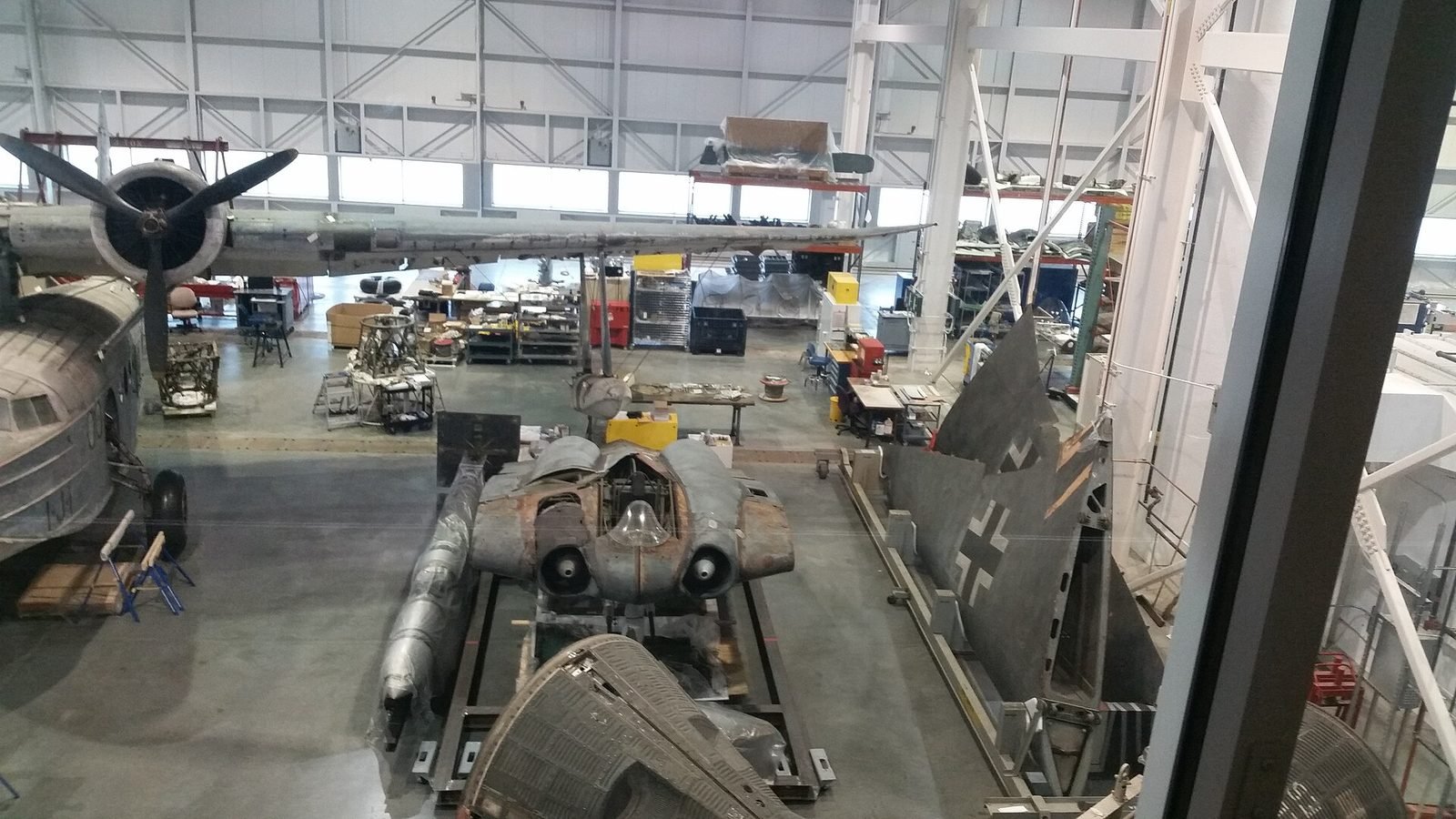
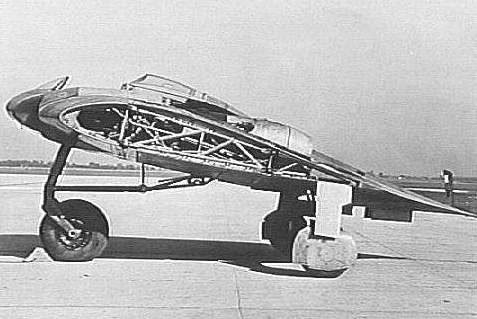
The Horten Ho 229 is a particularly useful starting point because an object survives. The Smithsonian’s Ho 229 V3 was an unfinished German all-wing jet captured in 1945. Its collection record identifies two Junkers Jumo 004B-2 turbojets and a construction combining familiar engineering materials. The museum traces its development, capture and preservation; this is a physical and documentary history, rather than a resemblance inferred from a photograph. [1]
The shape matters. Seen without context, a wing without a conventional tail can appear to belong to a different technological world. Once its engines, structure, development problems and custody are examined, the historical question becomes more specific: how did its designers attempt to make this particular aircraft work?
This gives us a productive standard for stranger claims. Ask for a comparable chain: named designers, dated calculations, suppliers, manufacturing facilities, flight-test records, surviving parts and independent examination. A genuinely revolutionary programme need not leave exactly the same records as a conventional aircraft, especially during war. Nevertheless, a machine large enough to build, move and operate has material requirements. An explanation of missing records should account for those requirements, rather than simply declaring the entire chain secret.
Unusual engineering is a reason to study the engineering. It is not an identification of the engineers’ teachers.



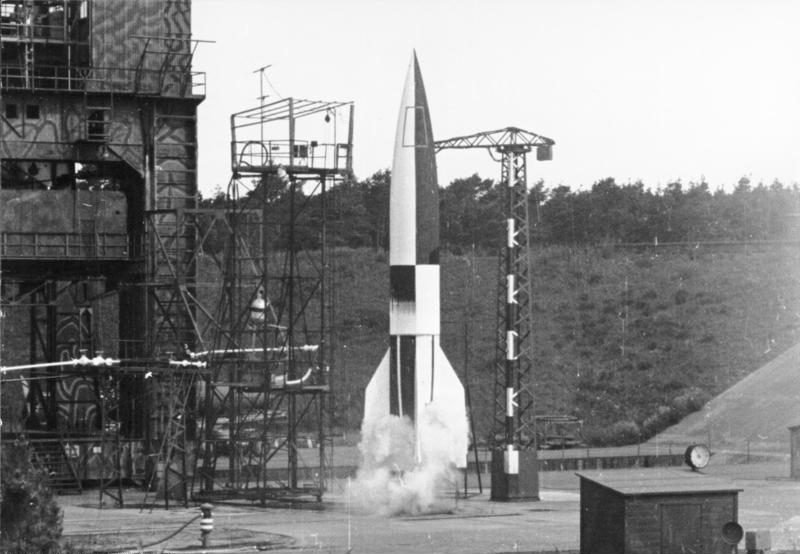
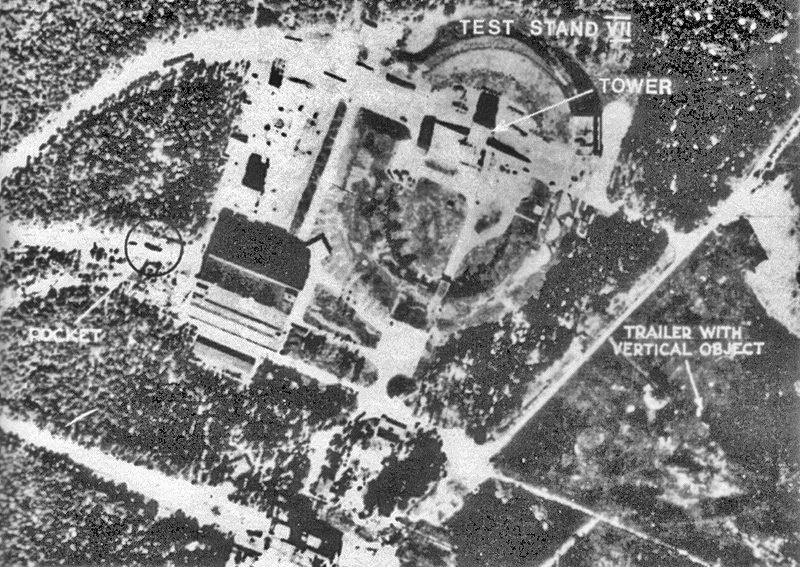
National Museum of the U.S. Air Force photograph. A documented German jet, for known wartime engineering. The photograph was not retrieved for this page. It is not evidence of extraterrestrial assistance.
3. The lights pilots called foo fighters
Wartime aerial reports belong in this history independently of the secret-disc stories. A Smithsonian retrospective draws on historian Richard Ziebart’s work and accounts associated with the U.S. 415th Night Fighter Squadron. It describes a November 1944 encounter involving pilot Edward Schlueter, radar observer Donald Meiers and intelligence officer Fred Ringwald: lights were reported near the Rhine, without a corresponding radar detection in that account. The article also traces contemporary press attention to Associated Press correspondent Robert C. Wilson in early 1945. [2]
What is significant here is the reported experience and its wartime setting. Aircrew encountering unexpected lights during combat had an immediate operational question: were they seeing an enemy device, a natural phenomenon, something associated with their equipment, or something else?
The surviving description must bear the weight of any later interpretation. Does it contain a solid outline or only a light? Was distance measured or estimated? Did a second crew see the same event? Was a manoeuvre observed against a stable reference? Did anyone recover an object?
A report without a radar return does not decide the matter. It also does not create radar evidence. If the original squadron log becomes available, its date, wording and operational context should take priority over a later compilation.
The honest overlap with modern UAP accounts is that trained observers sometimes describe unexpected aerial behaviour. The additional proposition that these lights were German-built extraterrestrial devices requires its own evidence.
4. When wartime discs became a public story
One important public checkpoint is the March 1950 Der Spiegel article “Sie fliegen aber doch”. In the historical transcription consulted here, Italian engineer Giuseppe Belluzzo claimed that wartime disc experiments had taken place under Hitler and Mussolini. The account describes a proposed rotating machine with a fuel-and-gas propulsion explanation and says its plans were lost. [3]
That is a valuable historical source for a claim circulating in 1950. It is not a 1942 test report. The difference between the date of the alleged experiment and the date of its public narration must remain visible.
It also matters what kind of claim was being made. A terrestrial inventor claiming a disc-shaped weapon is not necessarily claiming alien instruction. Later retellings can preserve the disc while replacing the proposed mechanism, introducing a different designer, adding an extraterrestrial source and presenting the enlarged account as if it had always been one story.
This is why a chapter on overlaps needs a history of transmission. If ten videos repeat a claim derived from this article, they show the reach of the article. They do not provide ten independent witnesses to a wartime test.
Conversely, a demonstrably independent engineering record would change the position. It should be evaluated on its own provenance, rather than rejected because later stories borrowed the same subject.
5. Vril: a word with a traceable literary past
“Vril” already had a public life before the Third Reich. Edward Bulwer-Lytton’s 1871 novel The Coming Race describes an underground civilisation and an extraordinary power bearing that name. The text is available for direct reading. [4]
A fictional origin for a term does not prevent later people from adopting it sincerely. Readers can turn fiction into aspiration, symbolism, spiritual practice or a claim about nature. The historical question is what happened between the novel and the alleged organisation or machine.
Three propositions therefore need separate treatment: people read about vril; people formed beliefs or associations around it; people built a working device using a real force corresponding to it. The first can be established by a book. The second requires records of the people and associations. The third needs evidence of an operating technology.
The novel cannot provide that final evidence. Equally, simply pointing to the novel does not investigate every later organisation. A serious inquiry follows the intermediate steps: names, addresses, publications, correspondence and the earliest appearance of the claimed technical vocabulary.
This approach leaves room for unexpected discoveries while preventing a familiar word from becoming a substitute for a missing history.
6. Haunebu, Maria Orsic and the claimed channelled designs
The names Haunebu and Maria Orsic belong among the course’s research questions because they recur in the wider secret-technology narrative. The proposition to test is consequential: that a clandestine circle received knowledge from non-human intelligences and helped produce extraordinary German craft. A portrait, drawing or repeated name is insufficient to establish that chain.
Historian of religion Julian Strube’s research traces a postwar genealogy of esoteric National Socialism, including Vril and Haunebu imagery. That genealogy supplies an alternative explanation for at least some apparent agreement: later authors may be inheriting a common narrative and visual vocabulary. The indexed research consulted here does not justify pretending that every associated document has been independently examined. [5]
For an Orsic-related claim, the decisive first questions are concrete. What is the earliest independently datable source naming her in this role? Is a purported message available in its original form? Who possessed it before publication? Does a wartime administrative, personal or technical record connect the named person to the claimed project?
For a Haunebu drawing, ask who created this particular sheet, when it entered a collection, and whether its terminology and materials fit the claimed date. A modern reconstruction may be an informative illustration. It must not be presented as a recovered engineering blueprint.
These questions do not assume that channelled communication is impossible. They ask whether this specific historical communication, person and technological consequence have been established. That is how a spiritual claim becomes a historical question that others can investigate.
7. Die Glocke and the difference between a device and an interpretation
The publisher’s description of Igor Witkowski’s Die Wahrheit über die Wunderwaffe, part 2, promotes a bell-shaped apparatus, counter-rotating fields and a substance called Xerum 525. It also places the account beside later interpretations concerning extraordinary propulsion. This is useful evidence for what a proponent’s publication claims. It is not a surviving experimental record. [6]
Several questions are often compressed into the name Die Glocke. Did an apparatus exist? What did it contain? What was its intended purpose? Did it operate successfully? Did it affect gravity? Was its knowledge non-human? Establishing an earlier step would not automatically establish the later ones.
Technical language can make these transitions difficult to notice. A story may name voltages, materials or rotating components without supplying measurements, a reproducible effect or an authenticated notebook. Specificity makes a claim easier to test; it does not perform the test.
The strongest next contribution would therefore be access to the underlying records with a defensible custody history, followed by independent historical and engineering examination. An unexplained drawing alone would leave the operation uncertain. A working reconstruction would demonstrate an effect, while still leaving the alleged wartime provenance to be investigated.
A claim this important deserves more than either an impressed repetition of its terminology or a dismissal based on its unusual subject.
8. Antarctica: place, expedition and later hidden-base accounts
A real German Antarctic expedition in 1938–39 provides a historical anchor for later narratives. It does not establish a permanent underground base. Summerhayes and Beeching’s original research examines that expedition alongside the U-530 and U-977 stories, Operation Highjump and Operation Argus. Their reconstruction rejects the specific hidden-base and attack scenarios they investigate on chronological, geographical and logistical grounds. Highjump was a 1946–47 U.S. operation, while the 1958 Argus tests were far north of Antarctica. [7]
This is stronger than an argument that a base merely sounds implausible: the competing account is tested against places, journeys and dates. Anyone proposing a revised version should identify which constraint the revision overcomes and supply the supporting record.
The chapter should also avoid allowing a real expedition to authenticate every later story attached to its destination. An expedition can explain why a place entered public imagination without proving the later construction claimed beneath it.
Useful discoveries would include dated supply movements, independent survey evidence or records identifying personnel and facilities. A dramatic landscape, an unexplained map marking or an image without reliable coordinates cannot carry the same historical weight.
Antarctica is thus an example of how to investigate an overlap: follow the real connection, then examine the additional claim instead of letting the first certify the second.
9. Paperclip: secrecy, technical advantage and responsibility
The postwar recruitment of German scientists is documented. National Archives finding aids identify the Joint Intelligence Objectives Agency and records associated with Overcast and Paperclip. An August 1946 memorandum in the State Department’s documentary series discusses the utilisation of German scientists and expansion of the programme. These records give the inquiry named institutions, policy decisions and an archival trail. [8] [9]
They also show why a government could pursue secrecy around advanced human technology: expertise could be treated as a strategic resource. No extraterrestrial premise is needed to make that motive intelligible.
The moral history matters just as much. The Interagency Working Group’s final report discusses recruitment, Nazi affiliations and the handling of security assessments. The movement of technical knowledge cannot be separated from questions about who was recruited, what they had done and what officials were willing to overlook. [10]
Actual concealment or compromised accountability deserves investigation in its own right. It cannot be used as a universal certificate for a separate allegation. “Some officials concealed damaging information” and “those officials possessed extraterrestrial craft” are different propositions.
Nor should the alien narrative displace human responsibility. Nazi persecution, forced labour and mass murder remain human actions within human institutions. Imagining non-human encouragement would not absolve perpetrators; without evidence, it can obscure the documented mechanisms of their crimes.
An intellectually serious account can investigate secret technology while keeping the people harmed by the regime in view.

10. The separate allegation of a 1933 recovery in Italy
David Grusch’s June 2023 NewsNation interview introduced many viewers to a different wartime claim. In the reproduced excerpts, he alleges that a partially intact vehicle was recovered at Magenta in 1933, held by the Italian authorities and obtained by the Americans around 1944–45 following a Vatican backchannel. This is an attributable assertion by Grusch. It is not an inspected 1933 recovery dossier. [11]
Its relevance is substantial if the underlying history can be established. A verified recovery before the Second World War would alter the chronology of alleged government involvement. It would invite research in Italian, Vatican and American records, rather than only in post-1947 U.S. files.
But the missing links should remain visible. Fascist Italy and Nazi Germany were distinct states. An allegation about Italian custody does not establish Hitler’s access. A later American transfer does not establish a German engineering programme. A recovered vehicle does not, without further evidence, establish communication with its makers.
The most useful corroboration would connect the alleged event to dated records of location, custody and transfer. Records created by different institutions could supply meaningful convergence if their provenance and independence were established.
Keep the setting straight as well: the Magenta account discussed here comes from a media interview. It should not be relabelled as a detailed recovery finding delivered under oath at the July 2023 congressional hearing.
11. Hitler in the Law of One
The Law of One offers a spiritual interpretation of Hitler. Session 35, recorded on 6 March 1981, describes attempted negative polarisation, confusion and a condition requiring healing after death. Its vocabulary concerns spiritual development within the teaching’s cosmology. [12]
That makes it relevant to a course comparing channelled accounts. It does not make the session a contemporary record of Hitler receiving a spacecraft or negotiating with a physically present extraterrestrial delegation.
A teaching may propose that human domination reflects a wider spiritual orientation. A historical claim identifies an event involving people, places and actions. The two can be compared without erasing their different forms of access.
Readers may find a spiritual interpretation meaningful, disturbing or unpersuasive. For the narrower historical question, ask what independently checkable information it adds. Does it identify a previously unknown document, an artifact or a location that can subsequently be verified? Without such a bridge, agreement in moral themes is an interpretive overlap rather than corroboration of a technological transfer.
The account must also be read without treating victims’ suffering as a convenient illustration of someone else’s spiritual progress. University teaching should preserve moral seriousness alongside freedom to examine metaphysical ideas.
12. What the comparison establishes—and what would change it
| Strand | Evidence available in the sources used here | Question still open at the next step |
|---|---|---|
| Horten aircraft | Surviving artifact and museum research | No demonstrated extraterrestrial design source |
| Foo-fighter reports | Accounts traced through historical reporting | Identification and reconstruction of particular events |
| Wartime disc claims | A postwar press claim and its transmission | Authenticated wartime construction and test evidence |
| Vril / Haunebu narratives | Literary antecedent and postwar narrative genealogy | Independently dated links to an operating wartime programme |
| Die Glocke | Proponent’s published account | Original records, apparatus and demonstrated effect |
| Antarctic base accounts | Real expedition; research testing later scenarios | Evidence overcoming the specific documentary and logistical objections |
| Paperclip | Government and archival records | Any separate claimed transfer of non-human technology |
| Magenta 1933 | Grusch’s attributable later allegation | Recovery, custody and transfer records |
| Ra’s Hitler account | A primary channelled transcript | Independent bridge to the proposed historical event |
This table compares the kinds of material available; it is not a numerical ranking of people’s honesty. A sincere speaker can transmit an incorrect account. A politically compromised institution can preserve an authentic technical record. Each source needs a claim-specific examination.
What can be understood now is a layered history. Real war, innovation and secrecy supplied the setting. Reports of unusual phenomena supplied unresolved experiences. Later literature and teaching supplied additional interpretations. The reviewed sources do not yet join those layers into an established history of Hitler’s extraterrestrial contact.
A future discovery should be allowed to change that assessment. Its value would come from what can be checked: provenance, date, custody, technical content and independent agreement. That openness is more demanding—and more useful—than deciding in advance that the whole narrative must be either revelation or nonsense.
Questions for study
- Which claim in this chapter has the shortest path from assertion to inspectable evidence?
- How could a historian distinguish an independent wartime source from a postwar account influenced by an earlier publication?
- What evidence would establish an unusual machine while leaving its alleged alien origin unresolved?
- Which specific discovery would most change your own assessment of the Hitler-contact claim?
Next: Chapter 10 · Disclosure: why withhold, and why speak now?
References and source notes
The references distinguish a witness’s statement, an investigator’s assessment and the chapter’s own analysis. An official host authenticates a document’s provenance; it does not automatically establish every assertion within it. URLs were checked or their indexed source text consulted during this review.
Smithsonian National Air and Space Museum, Horten Ho 229 V3 preservation project and collection record.
https://airandspace.si.edu/explore/researchers/projects/horten-ho-229-v3-preservation
https://airandspace.si.edu/collection-objects/horten-ho-229-v3/nasm_A19600324000
Locator: Project history; object A19600324000; propulsion and construction description. Source type: Museum research and conservation documentation of a surviving object. Use and limits: Supports the aircraft’s documented engineering and custody. Its unusual silhouette is not evidence of an extraterrestrial design source.
Zoe Krasney (2016), “What Were the Mysterious Foo Fighters Sighted by WWII Night Flyers?”, Air & Space / Smithsonian, August.
Locator: 415th Night Fighter Squadron accounts; November 1944 episode; Richard Ziebart interview; discussion of Robert C. Wilson’s 1945 reporting. Source type: Retrospective feature containing original historian interviews and quotations from historical accounts. Use and limits: Used for the reported episode and a route to wartime records. The underlying squadron archive was not independently audited here. No general technical claim about what radar can detect is taken from this feature.
Der Spiegel (1950), “Sie fliegen aber doch”, no. 13, pp. 33–35; reproduced in CENAP’s historical press collection (2010).
https://www.spiegel.de/politik/sie-fliegen-aber-doch-a-7a736440-0002-0001-0000-000044447768
https://alien.de/cenap/cenapnews/zeigen.php?satzid=9786
Locator: Opening historical reproduction: Belluzzo and claims of wartime disc experiments. Archive date 29 March; reproduced print attribution 30 March 1950. Source type: Contemporary newspaper claims accessed through a later transcription; original publisher URL supplied as a locator. Use and limits: The original publisher page could not be fetched in this review. The consulted transcription establishes what was publicly alleged, not that the alleged machines existed. Exact first-publication priority across all saucer claims is not asserted.
Edward Bulwer-Lytton (1871), The Coming Race; Project Gutenberg edition.
https://www.gutenberg.org/cache/epub/1951/pg1951-images.html
Locator: The subterranean civilisation and descriptions of vril, in the novel’s descriptions of its inhabitants and their technology. Source type: Original fictional work, public-domain edition. Use and limits: Establishes a literary use of the name and concept. It cannot establish whether every later organisation using that name did or did not exist.
Julian Strube (2012), “Die Erfindung des esoterischen Nationalsozialismus im Zeichen der Schwarzen Sonne”, Zeitschrift für Religionswissenschaft 20(2), 223–268.
https://doi.org/10.1515/zfr-2012-0009
Locator: Article’s genealogy of postwar esoteric National Socialism; indexed passages on Vril and Haunebu drawings and the 1950 press article. Source type: Original historical research; university metadata and indexed article text consulted. Use and limits: The full PDF fetch was blocked; no complete page-by-page reading is claimed. Used narrowly for the postwar genealogy and source-dependence problem, not as proof that every esoteric belief or disputed wartime event is invented.
Mosquito Verlag, publisher description of Igor Witkowski, Die Wahrheit über die Wunderwaffe, Teil 2.
Locator: Publisher description of Die Glocke, counter-rotating fields and Xerum 525. Source type: Primary promotional description of a proponent’s book. Use and limits: Identifies what the book promotes. A publisher’s description is neither a laboratory report nor verification of the alleged apparatus, documents or experiment.
Colin Summerhayes and Peter Beeching (2007), “Hitler’s Antarctic base: the myth and the reality”, Polar Record 43(1), 1–21.
Locator: Abstract and investigation of the 1938–39 expedition, U-530/U-977, Operation Highjump and Operation Argus. Source type: Original historical and geographical research. Use and limits: Addresses specified base and attack narratives using chronology, records and geography. It is not an exhaustive survey of all possible Antarctic activity.
National Archives, Nazi War Crimes Interagency Working Group, RG 330: Office of the Secretary of Defense.
https://www.archives.gov/iwg/declassified-records/rg-330-defense-secretary
Locator: Joint Intelligence Objectives Agency; Overcast / Paperclip personnel and technical records. Source type: Official archival finding aid. Use and limits: Establishes an accessible documentary trail for scientist recruitment and technical intelligence, not extraterrestrial technology.
U.S. Department of State, Foreign Relations of the United States, 1946, vol. V, document 448, memorandum of 30 August 1946.
https://history.state.gov/historicaldocuments/frus1946v05/d448
Locator: Memorandum concerning the utilisation of German scientists and expansion of Paperclip. Source type: Contemporaneous government document published in an official documentary series. Use and limits: Evidence for the policy’s stated technical and strategic rationale. The document is not evidence of an alien recovery programme.
Nazi War Crimes and Japanese Imperial Government Records Interagency Working Group (2007), Final Report to the United States Congress.
https://www.archives.gov/files/iwg/reports/final-report-2007.pdf
Locator: Discussion of Paperclip, recruitment, Nazi affiliations and security assessments. Source type: Official declassification programme report drawing on historical records. Use and limits: Supports the ethical and institutional history of recruitment. This chapter does not infer an extraterrestrial origin from secrecy or misconduct.
David Grusch / Ross Coulthart (11 June 2023), We Are Not Alone: The UFO Whistleblower Speaks, NewsNation; selected excerpts reproduced by nonhuman.life.
https://www.newsnationnow.com/space/ufo/we-are-not-alone-the-ufo-whistleblower-speaks/
https://nonhuman.life/nhi/news/2023/06/11/newsnation-exclusive-david-grusch-we-are-not-alone/
Locator: Excerpt headed “The crash retrieval program, spacecraft & the Vatican”; Magenta 1933 and 1944/1945 exchanges. Source type: Named interviewee’s claims, accessed through an attributed third-party excerpt reproduction. Use and limits: Not a contemporaneous Italian document, a firsthand 1933 account or a finding of Congress. Publisher URL is a programme locator; the consulted text is the reproduction. No full audiovisual audit is claimed.
L/L Research, The Law of One, session 35, 6 March 1981, questions 35.4–35.5.
https://www.lawofone.info/s/35#4
Locator: Hitler’s purported spiritual condition, attempted negative polarisation and post-incarnation healing. Source type: Primary transcript of a channelled teaching. Use and limits: Evidence of the teaching’s content. It is not a wartime witness statement, proof of physical alien contact or an explanation that removes human responsibility for Nazi crimes.